

Briefly from various directions.
1. Northern Slobozhansky (Sumy) direction
Fighting continues in the border area of the Sumy region of Ukraine in the directions of Kolotylivka — Pokrovka and Hrabovske — Riasne. The forward units of the enemy’s troops group (TG) “Sever” are trying to expand their wedge (currently up to 1.5 km), but so far unsuccessfully for them.
Fighting also continues in the tactical zone along the perimeter of the enemy’s wedge to the northeast of the city of Sumy. Despite several focused attempts by the advanced units of the Russian tactical group (TG) “Kursk” to advance southward, they have not yet managed to reach the line of Pysarivka-Maryine, or advance in the northeastern part of the forest area near Sadky.
2. Southern Slobozhansky (Vovchansk, Kharkiv) direction
The enemy (Russian troops), namely the consolidated TG of the 44th Army Corps (AC) and units of the 6th Combined Arms Army (CAA) “Belgorod/Kharkov”, reinforced with several units from the parts and formations of TG “Zapad”, continues stubborn battles in the area of Synelnykove — Tsehelne — Vilcha — Lyman, trying to ensure the advance of their forward assault groups in the area of Syminivka and Hrafiske from the eastern flank, southward along the Siverskyi Donets river.
However, so far they have not succeeded, as the Armed Forces of Ukraine stubbornly hold positions in the area of Lyman and Vilcha, as well as in the area of Prilipky, effectively hindering the Russian command’s efforts to intensify their efforts in this direction.
The forward small infantry groups of Russian troops that broke through to Syminivka and Hrafiske seem to be facing significant logistics difficulties. Most importantly, the enemy is unable to significantly increase their numbers, as the movement of personnel for reinforcement through the “corridors” that are being shelled by the Armed Forces of Ukraine from both flanks (west and east) is quite challenging.
On the “main” direction of Vovchansk — Bilyi Kolodiaz, Russian troops have not yet succeeded either. It is likely that the Russian command has somewhat shifted its efforts in this direction westward, trying to increase pressure on Ukrainian positions in the area of Vilcha, attacking them via the railway from Vovchansk, aiming to unblock their assault groups’ advance along the Siverskyi Donets.
3. Velykoburluk direction
The “repeated” attempts by the advanced units of Russia’s 69th Motorized Rifle Division (MRD) of the 6th Combined Arms Army (CAA) to reach the Khodne-Ambarne front line, as well as Novovasylivka-Mykhailivka, acting respectively from the direction of Milove and Krasne Pershe on their Oskil bridgehead, have so far been unsuccessful.
The 83rd Motorized Rifle Regiment (MRR) of this division, which has been trying to “take” Ambarne for the second month, has yet to achieve significant progress in this endeavor. The attempts by the advanced units of the 6th CAA to advance from Dvorichna towards Ridkodub, which they occasionally make along the Dvorichna-Velykyi Burluk road, also remain fruitless.
It is apparent that the command of Russia’s 6th CAA, forced to stretch its forces and resources across a rather wide front (from Kupyansk to Vovchansk) to carry out a range of operational-tactical tasks, will significantly limit its “appetites” in the near future and will most likely focus on executing 1-2 tasks.
Although this army includes two new “assault” divisions (respectively the 68th and 69th MRD), which were once the 25th and 138th separate motorized rifle brigades, they are clearly not enough for everything at once — for Kupyansk, for battles in the Vovchansk area, and also for attempts to advance on Velykyi Burluk from their bridgehead on the Oskil.
However, knowing the main principles of decision-making by the Russian command, it is entirely possible to assume that it will likely focus on Kupyansk and the expansion of its bridgehead on the Oskil in its southern part, rather than on “tactical fuss” in the border zone.
The 68th MRD of this army (121st and 122nd MRR), which operates there and actively assists the 1st Tank Army (TA) of the Western Military District (WMD) from the north in its offensive on Kupyansk, may be reinforced by a number of forces and means from the 69th MRD as part of such a decision.
4. Kupyansk Direction
The “sitting” of Russian assault remnants in the Central District Hospital of Kupyansk has apparently ended. Russian troops failed to unblock them, although they tried very hard to do so. Currently, it seems that the Ukrainian Armed Forces are “clearing” the area around the Spartak stadium and the territory adjacent to the Kupyansk “Extreme Park,” located north of the hospital remnants.
However, it should be remembered that it is unlikely that the Russian command will abandon active (in terms of offensive actions) in this direction entirely or significantly anytime soon. First of all, due to the moral-psychological issues in the information space faced by the higher military and political leadership of the Russian Federation in connection with events and their statements around Kupyansk. Accordingly, the Russian military itself will very persistently try to actually “take Kupyansk.” Since, evidently, the higher Russian military and political leadership will demand from them to somehow bring its loud statements about “taking Kupyansk,” made several months ago, into reality. After all, constant reminders of this humiliation in the information space cause it very significant reputational damage. Primarily, in the sphere of trust in it by Russian public opinion and by its subordinate Russian military members.
Therefore, the units and connections of the 1st Tank Army (Western Military District “Zapad”) operating in this direction — the 47th Tank Division, the 27th Separate Motorized Rifle Brigade, part of the forces of the 2nd Motorized Rifle Division and the 4th Tank Division, as well as the 6th Combined Arms Army (Northern Military District “Sever”), the 68th Motorized Rifle Division, will attempt under any circumstances to eliminate the bridgehead of the Ukrainian Armed Forces east of Kupiansk and capture the city itself in the near future.
Currently, the main efforts of the 1st Tank Army command are concentrated in the direction of Pishchane — Kurylivka, specifically in the area of the 47th Tank Division, which is trying at any cost to break through to Kivsharivka, consolidate there, and reach Kupiansk-Vuzlovyi with the main forces of its advanced units and detachments.
Meanwhile, the 27th Separate Motorized Rifle Brigade, advanced units of the 68th Motorized Rifle Division (6th Combined Arms Army), periodically try to break through to Zao–skil (the eastern part of Kupiansk) from the direction of Lyman Pershyi, and also towards Vilshana — Petropavlivka to restore their positions in the western (central) part of Kupiansk, attacking along the Oskil from their bridgehead on it.
The plan is quite obvious. To “cut off” the southern part of the bridgehead (thus pressing towards the river or forcing Ukrainian troops to withdraw from the Kolosnivyka and Hlushkivka area to the north), simultaneously hindering them from organizing a stable defense in the “Zao–skil” area and Kupiansk-Vuzlovyi.
So far, the enemy has achieved the following results in this regard:
– Probably, individual assault groups from the 27th Separate Motorized Rifle Brigade (most likely supported by units of the 47th Tank Division) managed to advance towards Vilshana — Petropavlivka, engaging in battles for the latter. In the area between Lyceum No. 7 and the Milk Canning Plant, north of Kucheriwka, separate “very small” Russian infantry groups were also recorded.
– In addition, assault groups of the 153rd Tank Regiment (47th Tank Division) apparently managed to hold the southeastern part of Kurylivka, having advanced there from Pishchane. Also, on the northeastern outskirts of Kivsharivka, there are likely a few Russian military personnel.
– However, the enemy clearly has not been able to break through to Kupiansk-Vuzlovyi or reliably cut the road between Novoosynove and Hlushkivka in three weeks of persistent offensive/assault operations.
The general operational situation in the Kupiansk direction at the moment, as I see it, can be characterized as an unstable equilibrium. This is determined by several factors, including:
– The command of the Western Military District “Zapad” is unlikely to abandon the assault and capture of Kupiansk in the near future, being “encouraged” to do so by higher Russian military and political leadership. Therefore, the enemy is unlikely to stop attacks on the positions of the Ukrainian Armed Forces on the bridgehead and in the city itself.
– At the moment, it is obvious that the forces of the Western Military District “Zapad”, active in this direction, require two things for the successful completion of this task — regrouping and reinforcement. Moreover, it would not be amiss to replenish the advanced units and detachments of the 1st Tank Army and the 6th Combined Arms Army with personnel, as they were considerably “exhausted” in this sense in previous battles for the city. It has reached the point where, in some cases, Russian regiments and brigades operating in the Kupiansk direction have no more than an understrength battalion of assault infantry or even several companies to conduct active offensive/assault operations in the tactical area in a more or less combat-ready state.
– However, at the same time, it should be remembered that, despite the fact that the task of capturing Kupiansk is currently quite relevant for the Russian military and political leadership, the Kupiansk direction is unlikely to become the “main content” of the entire summer-autumn campaign of the enemy. After all, it has a rather limited impact in the military-political (strategic) sense on the progress and content of the entire war. Even the hypothetical capture of Kupiansk by Russian forces is unlikely to be a significant reason for Ukraine to cease overall resistance to the aggressor, including the entire “great” operational-strategic Kharkiv direction.
– Therefore, the command of the 1st TA and generally the entire Operational Group “West” will be quite limited in terms of receiving reinforcements, mainly from the strategic reserves of the Russian command. Moreover, at this stage, it is already obvious that the command of the Operational Group “West” is currently focusing its main efforts on the Lyman and Borova directions (i.e., in the center and on the left flank of its entire operational zone), rather than on the Kupiansk direction. This, in turn, completely fits into the logic of the Russian command’s preparation for a large-scale offensive in the summer-autumn of this year on the Sloviansk-Kramatorsk agglomeration.
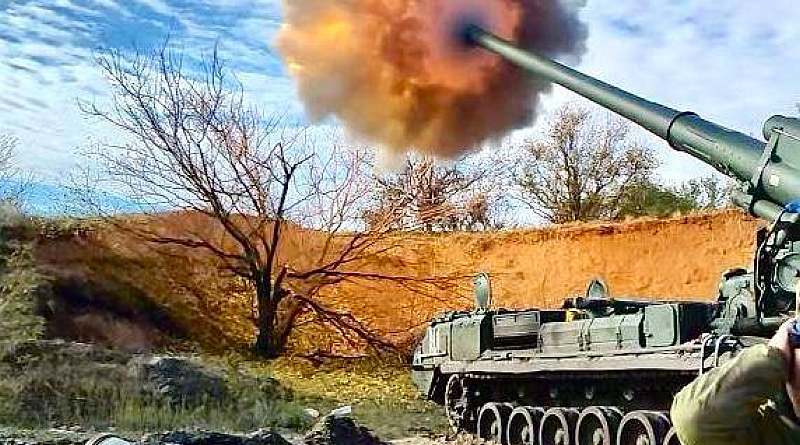
Photo: General Staff of the Armed Forces of Ukraine
