
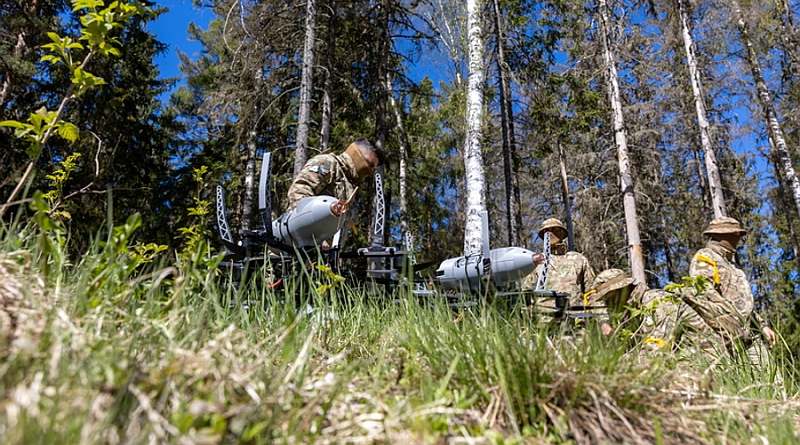

I will also speak out about the “Steel Hedgehog” exercises, where Ukrainian drone operators gave a hard time to the Royal Hussars in the form of OPFOR.
For some reason, I think that there were not just “drone line” pilots, but the Main Intelligence Directorate with experience in deep strikes in contested environments with electronic warfare. Purely based on their actions and depth of 40 km, that’s how I see it. So not general army external pilots, but an elite focused on breaking through electronic warfare.
Plus, it’s reported that “Rarog” and “Nemesis” were there, some of the first SBS units deployed from company to brigade level, also extremely experienced units with their own developments.
Apart from electronic warfare, there were no special senior commander means— F-35s acted as a command link and relay, tactical-level air defenses tried to work against UAVs.
So, to me, everything was logical: first they hit the control and communication, and the drones, which were aimed at targets through optics, couldn’t be jammed by any electronic warfare. Then, without “eyes” and communication shelters, having lost ground-based electronic warfare, they started picking up minor hits—anyone would. Additionally, there were hopping frequencies and queen drones, mining.
But it’s important to understand there were no other senior commander means, like batteries of German PzH 2000. In reality, they would have been entrenched in bunkers and even if they got hit by a couple of drones, they would quickly come up with nets and deep “cuckoos” —this isn’t higher mathematics. And they would also have crammed “bonuses” to drone operators in rotations and buses.
If a couple or three M270s appeared there, they would definitely hit the antennas and our shelters. If needed—they would have flown in a dozen “Rafales” with Hammers that fly into an eight-meter circle. And AWACS from Luxembourg would have transmitted data, and a communication channel with aviation would be set up, and a Saab Gripen E would arrive and add electronic warfare after the ground battle, not allowing FPV to roam freely.
They would have suffered losses, but they would have adapted. It was SBS and the Main Intelligence Directorate at work, and general army drones have a lot from the civilian market—NATO brigade means can triangulate the place of mass signal and not hesitate to hit there with an MRBM: be it Polish ATACMS or Danish LORA. And satellites, yes, can sketch positions.
In my opinion, NATO simply showed itself a drone war, and now they all want budgets for drones, companies, and battalions—workshops and juicy procurements are squealing. We sent some of the best, respected the allies, although they would have been useful here in the summer of 2025. But this is a preparation stage for us too—working against a powerful enemy with satellite communication and relay stations.
In short, I would not rush to headlines like “they’re done for”. Everyone got what they wanted out of this mess—the defenders got one experience, and OPFOR got another. In a real war, everything would be different and much harder for those trying to break into Suwalki. That’s how I see it, and why it went viral now, I don’t know. Yes, we showed them the technologies of the harshest selection of an 11-year war, and they took it to heart. Well, what did they expect?
But that doesn’t mean that all Russians can do this—they are lagging precisely in this, and that against such actions strategic forces have no remedy in the initial stage, when arsenals are still full.
Photo: Estonian Ministry of Defence
“We’re screwed”: Military exercises in Estonia showed NATO’s unpreparedness for modern drone warfare
