
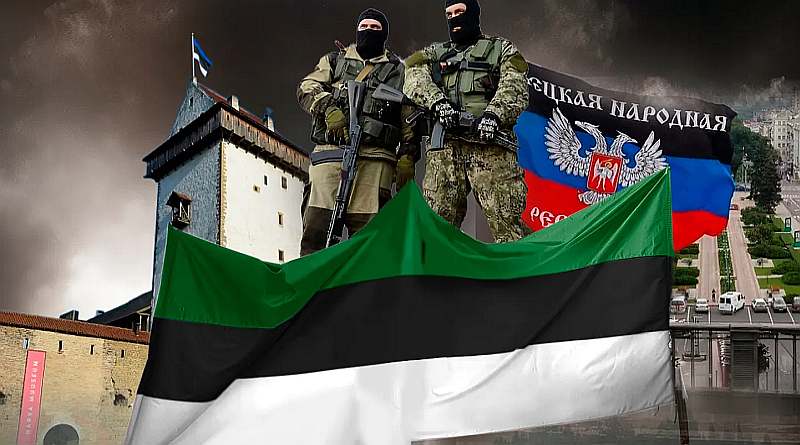

It seems that the Kremlin has finally run out of folders with new ideas and has resorted to the “proven” manuals from 12 years ago. A dangerous déjà vu is observed: in March 2026, amid the spring exacerbation, Russian special services sharply activated the “Narva People’s Republic” (NPR) project.
The scenario we are now observing in Estonia is more than just a regional crisis. It is a replica of the events of 2014 in Ukraine’s Donbas. Putin is trying to pull off the same trick in the Baltics that turned Eastern Ukraine into a humanitarian disaster zone.
If we go back to the events of the “Russian spring” in Donetsk and Luhansk, the current activity of the GRU and FSB in the border areas of Estonia will seem painfully familiar.
First, there is an information pump: suddenly, social networks and “gray” Telegram channels started talking about the “oppression of Russian speakers” in the city of Narva. Stories about the “ban on everything Russian” are being stamped out on an industrial scale, creating the illusion of an existential threat.
Secondly, “spontaneous” self-defense groups are starting to appear. In March 2026, strange “sports activists” and “concerned citizens” appeared in the border area, whose military bearing suspiciously betrays Russian security personnel.
Thirdly, attempts to seize administrations cannot be ruled out. The logic here is to provoke the Estonian police into a tough response to get propaganda footage: “Look, NATO is killing peaceful residents!”
In general, what is happening now in Narva resembles Donbas 2.0. Back then there were DPR/LPR, today there is an attempt to create the NPR. Then it was the mythical “protection of Russian speakers” from “Banderites”, today it is protection from the “aggressive NATO bloc”.
Putin doesn’t know how to create; he only knows how to create “gray zones”. His goal in 2014 was to drive a wedge into Ukraine’s unity and stop its European integration. His goal today is to do the same with the Baltics using similar tools: disinformation, espionage, and fear.
Putin doesn’t need Narva itself. He needs chaos within the EU and NATO. The main goals of Moscow in this adventure are to test NATO’s Article 5, and the Kremlin wants to know if the Alliance will go into a real conflict over a small border town. If NATO hesitates, the architecture of Europe’s security will falter.
The next step is the destabilization of the entire Baltics and the creation of a constant tension zone in Estonia, Latvia, and Lithuania to paralyze their economy and social life.
Putin is also concerned with internal affairs, needing an external “victory” under sanctions and isolation, and failures in Ukraine. It is the only way to feed Russians some illusion of greatness.
But there is one problem for the Kremlin: it is not 2014 now. The world has already seen this scenario. Tallinn, Riga, and Vilnius understand the risks perfectly. The level of readiness of the special services and the solidarity of allies are much higher today.
Narva is not a “weak link”, but a fortress of the civilized world.
For the Kremlin, crude attempts to revive the “Novorossiya” project on the banks of the Narva are a path to the final collapse of a regime that never learned to live in peace with its neighbors.
History repeats twice: first as a tragedy experienced by Ukraine, and the second time as a farce in the Baltics. But in Putin’s case, this farce may become his last adventure.
Collage: Rus.Postimees
