
Olena Abramovych / Radio Liberty
Czech volunteers raised over 6 million euros for Ukraine in just a few days, while Polish volunteers collected over 2 million euros. The “for generators” collections are being initiated by a number of civic organizations across Europe. Meanwhile, the French government coordinated a “collection” among the “Group of Seven” countries, as well as the northern and Baltic states.
Radio Liberty gathered examples of how and who in the EU is helping Ukrainians survive the winter under current conditions – often without heating following Russian attacks.
The Understanding of the Poles
“When heat and electricity don’t come, you have to drain water from the radiators. And then these housing estates become almost uninhabitable,” said Polish Foreign Minister Radosław Sikorski at the Ukrainian breakfast in Davos, trying to explain to European leaders what Ukrainians are experiencing this winter, living in centrally heated buildings.
“A significant part of Ukraine’s population lives in housing estates from the communist era, similar to those I grew up in communist Poland,” said Sikorski.
Currently, the residents of post-Soviet countries are helping Ukraine the most actively. For example, the Polish government, through the Agency of Strategic Reserves, sent 379 generators and 18 heaters to Ukraine, while the city of Warsaw added 90 generators.
Volunteers opened a separate collection – the Polish initiative “Warmth from Poland for Kyiv” managed to gather over 7.5 million Polish zlotys (over 2 million euros) and the first 130 generators have already been delivered to Kyiv.
The collection in Poland was initiated by Ukrainian Nataliya Panchenko, who, at the beginning of the full-scale invasion, stopped trucks heading through Belarus to Russia, demanding a trade blockade of the Russian Federation.
“In recent years, the anti-Ukrainian radical Polish faction launched a smear campaign against Natalki. For a while, her family was guarded by the Polish police, with daily threats and surveillance,” wrote Bogdan Logvynenko, her former colleague and founder of the publication Ukrainer, about the situation Natalia found herself in.
“Over 28,000 Poles have already joined. And this is despite all the dirt and hate organized by anti-Ukrainian forces. And this is despite the fact that under most posts about the collection, one can read thousands of comments with hatred towards Ukrainians. Such an image is very beneficial for Russia to see. But the reality is different: tens of thousands of Poles are donating, and the money continues to pour in every minute,” added Logvynenko.
Czech “Gift for Putin”
In the Czech Republic, one of the most well-known volunteer public initiatives to help Ukraine called “Gift for Putin” has already raised 153 million Czech korunas (6.3 million euros) for generators for Ukraine.
According to the words of the leader of this initiative, Martin Ondracek, donations increase every time the speaker of the lower house of the Czech Parliament, Tomio Okamura, makes anti-Ukrainian statements.
In November 2025, this Czech politician initiated the removal of the Ukrainian flag from the Czech Parliament building, which was displayed as a sign of solidarity after the start of Russia’s full-scale aggression.
On January 25, Okamura criticized the action in Prague “Chain of Unity” on the Day of Unity of Ukraine.
The Czech government also joined in helping Ukraine. Thus, according to statements by the Prime Minister of Ukraine, Yulia Svyrydenko, on January 26, the Czech government allocated $500,000 for the purchase of generators for the frontline Dnipropetrovsk region by the end of the week.
“Coalition” from Paris
On January 23, France initiated a coordination call with the “Group of Seven” countries, as well as northern and Baltic states, on urgent energy support for Ukraine.
As a result, the first Deputy Prime Minister – Minister of Energy, Denys Shmyhal reported that:
- France will provide over 100 generators with a total capacity of 13 MW;
- European Union – 447 generators;
- Germany – €60 million in support and additional equipment, including 33 cogeneration units, 15 mobile hybrid generators, 300 photovoltaic installations, 375 batteries, 31 boiler units, 45 pieces of construction equipment, and 10 boilers;
- Italy – €10 million to the fund and an additional €50 million earmarked in the budget for 2026;
- Japan – 140 small and medium-sized generators, 60 transformers, 2 cogeneration units;
United Kingdom – nearly €23 million to the fund;
USA – over $400 million for humanitarian support projects for Ukrainians this year;
Lithuania – 90 generators.
“We plan to deliver some of the generators from international partners to SES heating points to supply people with electricity during outages. We expect additional equipment from Slovakia, Switzerland, the Netherlands, Azerbaijan, Italy, Latvia, Poland,” said Shmyhal on January 24.
- Since the beginning of the full-scale invasion in February 2022, Russia has been targeting Ukraine’s energy infrastructure. From the beginning of autumn 2025, Russian forces intensified shelling of Ukraine’s energy sector.
- After the latest massive attacks by Russia, Ukraine’s energy system remains under a state of emergency, with the most severe situation in Kyiv and the Kyiv region. In Kyiv, 926 apartment buildings remain without heating following Russian strikes in several districts on the left bank of the Ukrainian capital, reported President Volodymyr Zelensky on January 27, after a meeting with government officials. According to city authorities, heating of most of these buildings was restored or attempted to be restored twice after previous massive shelling on January 9 and 20.
- The Russian leadership denies that the Russian army is targeting the civilian infrastructure of cities and villages in Ukraine during the full-scale war, killing civilians and destroying hospitals, schools, kindergartens, energy, and water supply facilities.
- The Security Service of Ukraine classifies Russia’s strikes on Ukraine’s energy infrastructure as crimes against humanity. The SBU previously mentioned that since the beginning of this year’s heating season, it has documented at least 256 air attacks by Russia on energy and heating systems in Ukraine.
- The American Institute for the Study of War (ISW) notes that the intensification of Russia’s long-range strikes on Ukraine’s energy sector aims to divide the country’s energy system into separate “islands,” cut off from production, supply, and electricity transmission. Analysts emphasize that these attacks underscore Ukraine’s urgent need for additional air defense systems, particularly the Patriot systems and interceptor missiles.
Copyright © 2021 RFE/RL, Inc. Reprinted with permission from Radio Free Europe/Radio Liberty
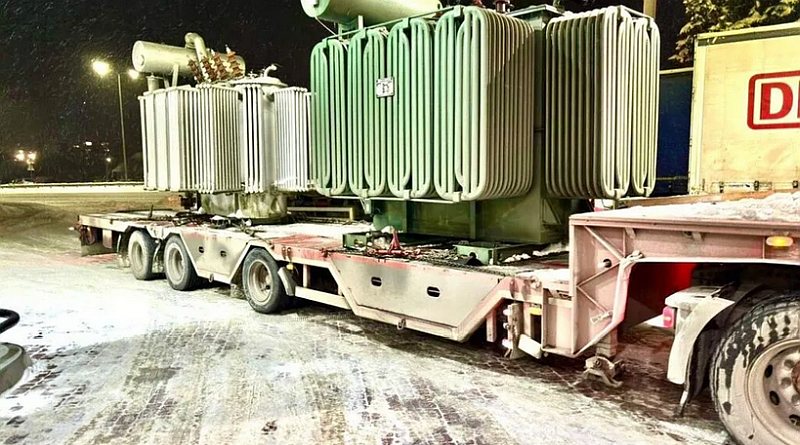
On the cover: Italy, Belgium, Czech Republic, and other countries are providing Ukraine with generators and boilers to restore the energy system. Photo: Andriy Sybiha/Facebook
