
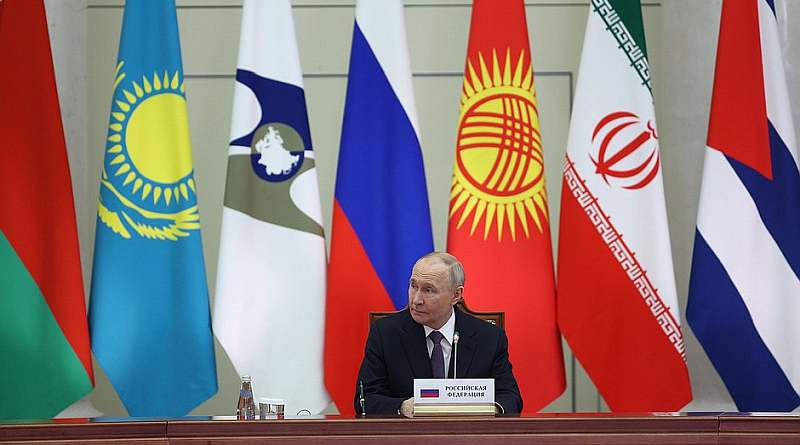

President Putin sent greetings to the participants of the first ministerial conference of the International Organization for the Russian Language. In his typical manner, the dictator called the Russian language a “common heritage of the CIS countries” and an “indispensable means of communication.”
At first glance, standard, routine diplomatic rhetoric. But in reality, it is yet another attempt to revive the stillborn “soft power” project, which in the hands of the Kremlin has long turned into a “hard tool” of hybrid aggression.
In this light, the promotion of a new structure for the dissemination of the Russian language based on the CIS with the participation of Belarus, Kazakhstan, Kyrgyzstan, Tajikistan, and Uzbekistan occurs against the backdrop of the deepest systemic crisis of the so-called Commonwealth. Today, the CIS is no longer an alliance of equals but a waiting room for those who have not yet found the courage or geopolitical opportunity to finally distance themselves from Moscow.
While Putin eloquently talks about “good neighborliness,” Moldova systematically and definitively denounces agreements within the CIS, choosing a European development vector. Chisinau clearly demonstrates that membership in structures under the auspices of the Russian Federation brings neither security nor prosperity.
For Central Asian countries, supporting such dubious initiatives is more a way to “appease” an aggressive neighbor than a sincere desire to strengthen humanitarian ties.
Meanwhile, the main tragedy ignored by the Kremlin is that the Putin regime itself dealt the most crushing blow to the spread of the Russian language worldwide. Today, the Russian language is less and less associated with literature and culture in an international context, and more and more with the language of those who destroyed Mariupol, Avdiivka, and Bakhmut, those who crushed the once-important industrial center – Donbas.
For millions of people, especially in Ukraine, the Russian language has now become the language of orders for shelling residential neighborhoods, the language of interrogations in filtration camps, and the propagandistic rants on federal trash television.
When Putin slyly calls the language a “common heritage,” he forgets to mention that he turned it into a marker of “us vs. them.” Linguistic expansion has become a precursor to subsequent tank columns and drone swarms. The concept of the “Russian world,” where the borders of language supposedly define the boundaries of the state, has turned philology into an excuse for horrific genocide.
The creation of the International Organization for the Russian Language is not about culture at all. It is an attempt to institutionalize control over the information space of neighboring countries. Through educational quotas, textbooks, and “cultural centers,” the Kremlin plants its narratives, undermining the sovereignty of independent states.
In a situation where Russia’s real economic and military appeal is nearing zero, Moscow clings to linguistics as a last leverage of influence. But this leverage works increasingly poorly. CIS countries see how the “protection of Russian speakers” has become a universal pretext for military invasion and the annexation of territories. Hence the reverse reaction: forced Latinization of alphabets, derussification of education, and a shift to national languages as the only way to protect against the “friendly embraces” of the neighbor.
No conferences or ministerial meetings will wash the Russian language from the blood that Putin’s adventure in Ukraine has stained it with. As long as Moscow uses linguistics as a tool of hybrid warfare, the “core interests of friendly nations” will be to stay as far away from this “heritage” as possible. The CIS is turning into a playing field for one man’s imperial ambitions, and the Russian language, unfortunately, becomes a hostage to his terrorist expansion.
