
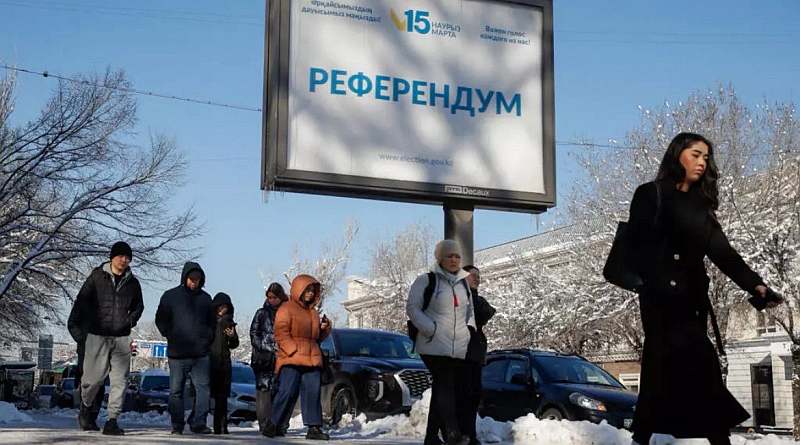

The results of the Kazakh constitutional referendum on March 15, 2026 – 87.15% “in favor” – became more than just dry statistics from the CEC. Here, Astana showed Russia an official certificate of divorce. Moscow is still mired in attempts to hold onto the past; Kazakhs have now definitively and irrevocably formalized their exit from the “Russian world” both de jure and de facto.
President Tokayev rewrote 84% of the old 1995 constitution. The main external change consists of transitioning to a unicameral parliament model, which is now called the National Kurultai.
But it’s not just about naming. This is a symbolic gesture of decolonization. Rejecting the Soviet-Russian model of a bicameral parliament in favor of the Turkic tradition is a direct signal to Moscow: “We are no longer your younger brothers in the CIS; we are now part of the great Turan.”
The new power architecture concentrates levers in the hands of the president, introducing a vice-presidential position and increasing control over the judicial system. This is a “super-presidential republic 2.0,” but with a Kazakh national flavor.
Why does Tokayev need the reform? The March referendum nullifies the last shadows of the “Nazarbayev era.” Tokayev is finally clearing out the old clans, replacing them with his technocrats to strengthen his own position. There is also a distancing from the “January debt,” when in 2022 the Kremlin believed it had bought Tokayev with the introduction of CSTO troops. The 2026 referendum became the final point in the operation to “repay the debt.” Tokayev shows that his power relies on the “will of the people,” not on the neighbor’s bayonets.
The world’s reaction to the referendum is telling. The West criticizes it for “strengthening authoritarianism,” but is willing to overlook this for the sake of stable resource supplies. On the other hand, the East is pleased with the changes. For Turkish President Erdogan, the referendum in Kazakhstan is a holiday. Strengthening the “Kurultai” and emphasizing Turkic identity is a clear victory for Ankara’s soft power. Kazakhstan is increasingly integrating into the Organization of Turkic States, purchasing “Bayraktars” and moving its army to NATO standards under Turkish mediation.
Meanwhile, China got what it wanted—a predictable partner. While Russia loses markets, China enters Kazakhstan with billion-dollar investments in logistics and energy. For Xi Jinping, Tokayev is a key operator of the “Belt and Road Initiative,” who no longer looks back at reprimands from the Kremlin.
For the Kremlin, the outcomes of the March 15 referendum are a kind of geopolitical upheaval. Its influence is waning because Moscow is no longer the security guarantor in the region. The role of “big brother” has shifted to China, and the role of “cultural guide” to the Turks.
The new constitution also effectively enshrines the dominance of the Kazakh language, leaving Russian with an “official” status that is increasingly becoming a formality. This is the end of the dream of a “unified humanitarian space.” Tokayev masterfully uses the referendum as a shield: “The people voted for sovereignty; we cannot make concessions that infringe on our independence.”
The Kazakhstan of 2026 has become a power that has learned to skillfully exploit Russia’s weakness during the “special military operation.” Tokayev turned the referendum into an instrument of soft “escape from guardianship.” Moscow still sees Kazakhstan on its map as its “southern frontiers,” but everything on the map itself has long been written in Latin letters with an orientation toward Beijing and Ankara.
