
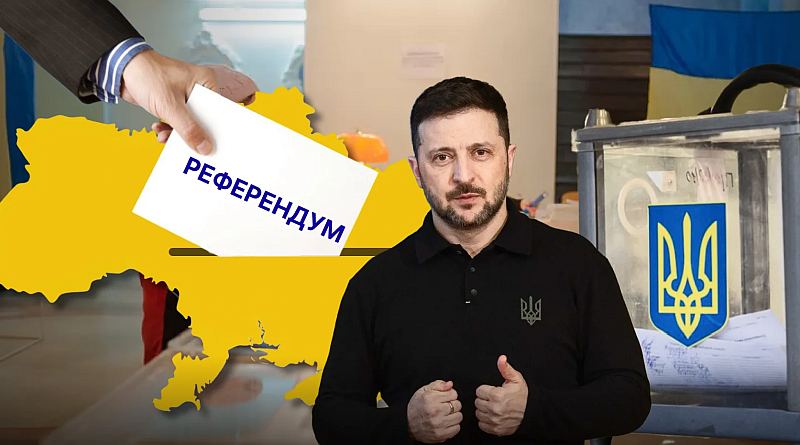

The wave about presidential elections and a referendum on surrendering Ukrainian territories has started again. And I wouldn’t be surprised if the Zelensky administration soon begins to implement this scenario.
However, this will not be a salvation for the sake of peace. On the contrary, it will start tearing Ukraine apart from within. Here’s why:
– without a ceasefire and lifting martial law, the voting will not be legitimate for a large number of citizens. And how many will not be able to vote, especially among the military? The winner will not have legitimacy and trust. This will undermine and weaken the entire government overall. The consequence – social explosions and political instability. The Kremlin will be happy. Once again – restrictions on rights and freedoms, censorship, and the omnipotence of law enforcers – this is a reality that is incompatible with elections. Especially in a country that aspires to join the European Union.
– the very fact of putting the territorial issue to a referendum will cause a severe division and internal conflict among citizens. To the delight of Russia, which dreams of this. Not to mention the illegality of such a referendum altogether
– any result will not be accepted overall. Elections under the restrictions of martial law are more reminiscent of the Russian world. There’s nothing of European values there. Deviating from solid democratic principles in such matters is unacceptable, as it will be difficult and painful to restore them. We’ve already been through this with Yanukovych.
Therefore, no elections without preparing the appropriate conditions: a prolonged ceasefire, lifting martial law, and full restoration of democratic institutions and human rights. Only then can we elect freely.
Only, I see, the president is afraid of free elections. That’s why he will push a surrogate to society.

What has happened to Ukrainian politicians, experts, commentators?
Political technologists of interested groups on both sides of the “agreements on the distribution of Ukraine’s natural resources” have once again launched this empty discussion into the information space about the end of the war, elections, referendum in May… And they “bought into” it. Again, money for nothing.
And what about the Russian cruise and ballistic missiles that fly to Ukrainian territory every day?!
And what about the Constitution, laws, the social contract?! Ultimately, common sense?
It seems the word “referendum,” “referendum,” “referendum” will be repeated on purpose, so that everyone becomes psychologically accustomed to it. It’s like when Donald Trump repeated about thirty times the mythical $350 billion he expects to receive from Ukraine. Initially, it seemed strange, but now it’s not funny at all.
It’s nice, of course, to think in terms of peace rather than war. And democratic processes for Ukraine, including elections, are indeed important.
However, all this is now being “broadcast to the public” not to develop realistic plans, but, pardon me, to “use” your brain to format the desired perception of the political agenda and the implementation of “forced decisions” and “complex issues.”
It would be nothing if “conversations don’t hurt!” But several points are alarming:
Firstly, even partners emphasize that if in May it’s “peace and elections,” then why does Ukraine need more weapons and assistance now?
Secondly, if it’s “peace and elections,” then why go on heroic assaults and stand to the death on the front lines?
Thirdly: if it’s “peace and elections,” then by what means is it possible to confirm in such conditions the fairness, freedom of expression, and ultimately the legitimacy of the election results?
Until you answer these questions, “Don’t push the horses!”
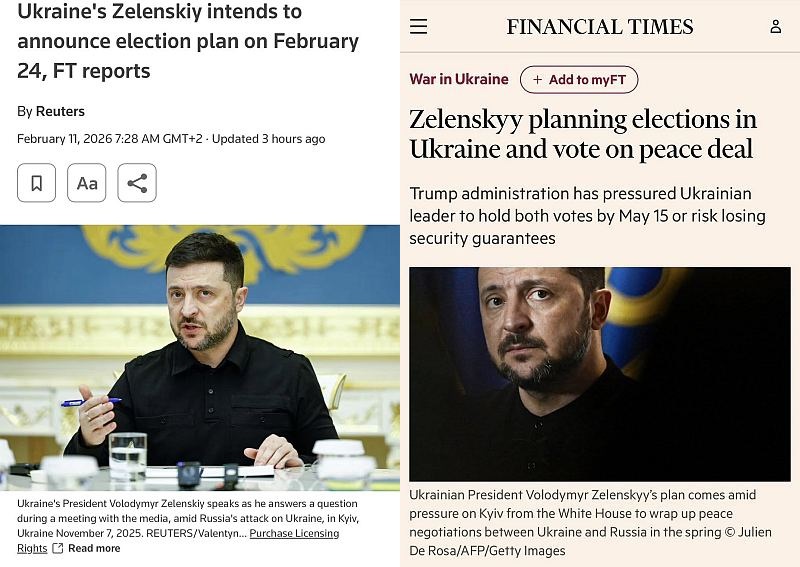
Last week, Reuters, and now also the Financial Times, publish as “information from sources” what has long been simmering in the corridors of power in Kyiv and spilling over into political circles.
Allegedly, some “peace deal” will be reached in March, elections will hastily take place in May, – and Volodymyr Zelensky supposedly intends to announce all this on February 24th, the anniversary of the invasion.
The first reaction is the sacramental “but this has happened before,” with which Leonid Kuchma went down in history. Before New Year’s, a similar announcement was expected in the New Year’s address. Before that – “at Easter.” Before that – “in spring”… and so step by step.
The next predictions will probably be about Easter again – fortunately, for the Orthodox, it is early this year, on April 5th (by the way, according to folk predictions, this might mean an early spring, which would be very welcome after this winter).
However, there is an element that changes from attempt to attempt. The wear and exhaustion of Russia. So far, they hope that Ukraine is wearing down and exhausting more. Therefore, they expect us to fall first. We have always fallen in history.
Therefore, a truce will not come “by itself.” Russia will have to be forced into it. Allies do have leverage. Just the announcement of sanctions against Lukoil and Rosneft, threats to intensify “secondary sanctions” against Russia’s accomplices dealt a very strong blow and forced them to at least simulate negotiation efforts.
There are means and there is something to pressure. The question is whether this pressure will be applied. And what it will be aimed at.
Although in reality, the “decision mathematics” is very simple. For Russia, the cost of continuation must exceed the cost of stopping. Because the latter is more or less known: the influx of hundreds of thousands of murderers and marauders into towns and villages; economic problems that can no longer be blamed on the war; the question “what was it all for?” when more than a million Russians were ruined, fought longer than in the “patriotic” war, and only increased the seized Ukrainian land from 7 to 20 percent at this price.
That is why Putin and his associates boast, talking about “our goals” and the “initial causes of the conflict.” And under this, they demand to “give them a prize.” There is a big problem with this logic — and not just one. First, Russians always want more. Second, they will always lie. Third, they have not given up on their aggressive plans and do not even hide it — and no “guarantees” except the real threat of military confrontation with NATO (primarily the USA) will stop them.
Therefore, to stop the war is not to “give Russia a consolation prize.” This path will only prolong the war.
To stop the war is to stop Russia. Force it to an unconditional and complete ceasefire. This is what all efforts should be directed towards — supporting the Armed Forces of Ukraine and strengthening sanctions to raise the “cost of continuation” for Russia and push it to accept the “cost of stopping.”
But here the Ukrainian authorities may play into the hands of the Russians. Because they heard the sweet phrase “elections despite the war.” That is, during martial law. That is, cutting off all oxygen to opponents and ensuring re-election for themselves.
However, elections during martial law are not elections. Without democratic conditions, without observers, without conditions for full voting and candidacy of military personnel, IDPs, refugees — the legitimacy of such elections will be in great question. This will create grounds for internal conflict, which Russia very much desires.
Therefore, it is critically important for Ukraine not to falter now. Not just to remain in negotiations, but to use them to talk about the real mechanism to stop the war. Forcing Russia to cease fire. Everything else is an illusion.
Collage: Focus
