
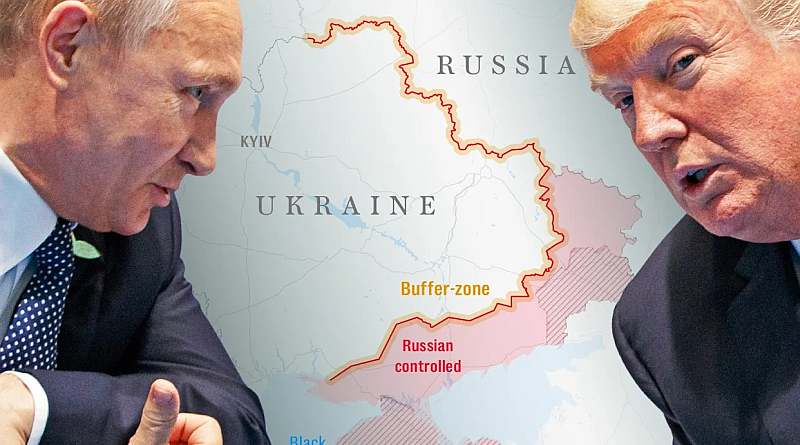
As the war in Ukraine enters its fifth year, it’s time for Europe to stand up to Putin on its own terms and for Trump to be told to get lost, writes Guardian international affairs columnist Simon Tisdall.
From a European perspective, the U.S. failure to protect the Ukrainian people from Russian aggression is the largest and most serious of a series of recent American betrayals, according to a columnist for the British publication and former editor and correspondent in the White House.
And it’s not just about the disgusting deference to Vladimir Putin, who is accused of war crimes. It’s not just about victim blaming and intimidating Kyiv into concessions. It’s not even the crude attempts to monetize the war and turn the suffering of millions into Nobel glory, while undermining NATO allies and violating sovereign rights.
What truly shocks and hurts is the blatant dishonesty displayed by a country that Europeans have always considered a friend, writes the British publication’s columnist, quoting the 18th-century English Gothic writer Ann Radcliffe: “Few things can be more painful than the betrayal of those we trusted.”
“Europe will remember,” Simon Tisdall believes.
How Trump and Putin are Alike
As the fourth year of full-scale war launched by Putin ends and the fifth begins, “Europe, like Russia, is in big trouble.” But so is the U.S. — losing its global leadership to the delight of China.
Autocrats everywhere are rejoicing, and far-right parties are gaining popularity in Europe.
“The question of how this war will end is really an existential question for Europe,” the Guardian article quotes Wolfgang Ischinger, head of the Munich Security Conference. “It will define — in many ways — the future of this continent.”
But beyond this, the war in Ukraine “will be defining for Trump and his blind, fanatical MAGA ideology,” the Guardian columnist believes.
By ignoring Russia’s predatory actions (and the unlawful coup in Venezuela), U.S. Secretary of State Marco Rubio in Munich targeted globalization, “climate cults,” and multiculturalism, calling for a return to nationalism, protectionism, closed borders, and Christian culture. “Yesterday is over,” he declared.
But in reality, “little Marco (as Trump calls him) is wrong,” Simon Tisdall asserts.
“Trumpism is the recreation of yesterday, a fantasy about the ‘good old days,’ and Putin suffers from the same ailment.
“The war is part of his revanchist project aimed at making Russia great again, rebuilding the Soviet sphere,” writes the Guardian columnist.
Under these conditions, “an open, freedom-loving, diverse Europe of democracy and the rule of law — is a living reproach to these clumsy retro Frankenstein monsters and their far-right imitators. They despise and fear her. Like Ukraine, Europe stands in their way.”
Betrayed More Than Once
However, as the Guardian commentator notes, America’s betrayal of Ukraine did not start with Trump.
Bill Clinton’s security guarantees for Kyiv after independence in 1994 turned out to be worthless. Barack Obama was taken aback when Putin annexed Crimea in 2014. Joe Biden, haunted by the ghosts of the Cold War, reacted with fatal over-caution to the 2022 invasion.
The change is that Trump’s betrayal is conscious and happening now.
“Last year, civilian casualties in Ukraine reached the highest annual level since the war began, as Putin expanded the conflict Trump promised to end in 24 hours. Direct U.S. arms supplies were reduced almost to zero. Trump’s ludicrous “peace process,” under the supervision of a business associate and his smiling son-in-law, panders to Putin’s maximalist demands while excluding Europe,” writes the Guardian.
Trump’s 28-point “peace plan” – a “one-sided roadmap to Russia’s victory” – was quickly discredited.
However, the commentator reminds, Trump still insists on Kyiv surrendering sovereign territory, “creating a catastrophic precedent and withholding security guarantees.”
He still seeks to profit quickly from Ukraine’s mineral resources and post-war deals with Russia.
He still continually bullies Ukraine’s president, Volodymyr Zelensky.
And he still demeans European allies while courting Putin.
Ukraine as the Line of Defense for Democracy
But, the Guardian author believes, Trump’s toxic tyranny will last as long as it is tolerated.
Despite all the obvious obstacles and challenges, it is crucial that, on the eve of the U.S. midterm elections, Europeans and the American majority who oppose Trump begin to speak with one voice – and match words with actions, the international commentator believes.
“And where better to start than with Ukraine, the actual and symbolic frontline in the battle between liberal democracy and the Trump-Putin axis?” the Guardian author rhetorically asks.
And provides practical advice:
- deploy troops from a European “coalition of the willing” to ensure the security and protection of Kyiv and other Ukrainian cities,
- implement a no-fly zone,
- increase supplies of missiles and drones,
- “bring ashore” Russia’s shadow fleet,
- strengthen resistance to the Kremlin’s hybrid warfare.
Europe should demand an immediate ceasefire, followed by a phased withdrawal of Russian forces, and should take a leading role in any final settlement negotiations, the commentator believes. And considers the real alternatives: endless war or an unstable, unjust peace on the terms of Trump-Putin.
In the opinion of the Guardian author, Europeans need to realize: everything they value is now at stake.
“Regardless of how it’s done, for the sake of Ukraine’s exhausted, undefeated people and their own future peace and security, Europeans (including the UK) must finally find the unity, courage, and resources to launch a military, economic, diplomatic, and moral offensive, writes the Guardian’s international commentator.
Europe must bring the fight directly to Putin’s doorstep. And tell Trump to get out.”
