
Oleksandr Kovalenko / Obozrevatel
Events in Iran have raised many questions among Ukrainians, particularly how they might affect our country and the war. It is known that Iran aided Russia and supplied Shahed-136 kamikaze drones, but the production has long been localized in Russia itself. However, that is not all.
Read more about this in the joint project material by OBOZ.UA and the “Information Resistance” group.
Before delving deeper into this topic, I want to mention a very important aspect – the moral and ethical one. The current strikes on Iran can be explained by the internal and external policies of the US, Donald Trump’s desire to control a Middle Eastern oil country and many other reasons. But that is their business, for us strikes on Iran are primarily an act of justice against a country that has systematically helped and continued to help Russia kill Ukrainians since 2022.
It’s unlikely that any of the Iranian leadership and military leaders would end up in the dock at The Hague. Hence, sending them six feet under – is fair.
Now let’s move directly to the cooperation between Iran and Russia.
Supplies from Iran
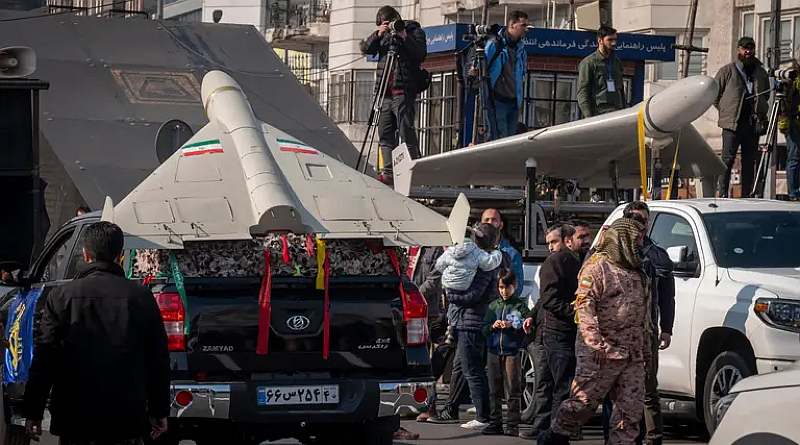
When we talk about weapon supplies from Iran to Russia, we primarily mention Shahed-136 kamikaze drones. They became not only the main symbol of terror and the genocide of Ukrainians but also, by their presence in the media space, overshadow Iran’s other assistance to the aggressor country.
In fact, before supplying Shahed-136 (to which we will return), Iran delivered other products to Russia in the initial months of the full-scale war in Ukraine.
Equipment for ROV soldiers:
body armor – Rouin-3;
helmets – NIJ II.
Ammunition:
203-mm for 2S7 “Pion” artillery;
152-mm for D-20 artillery;
130-mm for M-46 artillery;
125-mm tank OF shell;
122-mm for D-30 artillery;
122-mm for BM-21 “Grad” rocket artillery;
120-mm for mortars.
Aerial bombs – Ghaem-5.
Anti-tank missile systems – Dehlaviyeh.
As for UAVs, Russia received from Iran besides Shahed-136 its lighter version Shahed-131 and the reconnaissance drone Mohajer-6.
For several years, there were consistent reports that Russia received ballistic missiles from Iran, specifically, there were mentions of alleged deliveries of Fateh-110, Zolfaghar, Dezful, and Fath-360. However, to date, there is no verified fact of the aggressor country using Iranian ballistics, nor of directly receiving these missiles.
But this does not mean that if Iran continued to produce these products without hindrance, it would not expand direct ballistic supplies to Russia. A vivid example is North Korea, which supplies KN-23 ballistic missiles, copies of Russian 9M723.
In 2025, Russia significantly scaled up the production of ballistic missiles of the 9М723 type (“Iskander-M”), and using ballistics against Ukraine’s rear areas became a priority.
If in January 2025, the Russian Armed Forces used 28 ballistic missiles against Ukraine in a month, then in January 2026, it was 91, and February set an absolute record – 121.
Thus, the appearance of Iranian ballistic missiles in Russia and their strikes on Ukraine was only a matter of time.
Therefore, the war in Iran weakens a serious and promising ally of Russia in the production and supply of weapons. But equally interesting is the cooperation in technology exchange.
The Evolution of Shahed-136
During the massive strikes on the Gulf Arab countries using ballistic means and kamikaze drones, UAVs with Russian markings “Geran-2” were also used. This immediately raised the question: is Russia supplying the same Iranian analogue Shahed-136 “Geran-2” to Iran for striking neighbors?
The answer is both yes and no.
The fact is, from the moment of receiving the first Shahed-136, Russia not only began to actively use them for terror against Ukraine but also constantly tried to improve, enhance characteristics, make them more effective in breaking through air defenses and more lethal.
First of all, the Russians tried to improve the control and accuracy of Shahed-136 by adding GLONASS modules. Then the heat-loving drones faced fuel system problems at low temperatures, which were addressed by improving the quality of materials and components. Similarly, Russian flight control blocks B-101 and navigation modules “Kometa” were installed on the drone, in conjunction with the satellite navigation block “B-105”. Russian manufacturers revised the Shahed-136 fuselage concept, including its strength, implemented through a honeycomb structure.
They tried to increase the destructive effect with constant experiments on warheads – from classic fragmentation high-explosive types of varying masses (from 40 to 90 kg) to thermobaric incendiary types, tandem, and so on.
Russia constantly modified the Shahed-136 kamikaze drones. And not only used them for terrorizing Ukraine, but also transferred some samples to Iran for study and integration of useful improvements in their production versions. A similar exchange was from Iran’s side, and thus, among the downed Russian versions of the Shahed-136 with “Geran-2” markings in Ukraine, Iranian-made drones were also found, which continued to be supplied to the Russian Federation.
In the past year alone, Russia used over 30 variations of Shahed-136 against Ukraine. The technology exchange between Iran and the Russian Federation is imaginable.
Therefore, even at this stage, strikes on Iran mean not only disrupting the production of Shahed-136, depleting the reserves of the terrorist state, but also limiting technological interaction.
But that is not all.
Three Other Benefits for Ukraine
Strikes on Middle Eastern countries have shown how vulnerable they are in terms of rational, balanced air defense. The war in the region has drawn attention to Ukrainian interceptor drones. Today, they are seen as a cheap alternative to the costly Shahed-136 intercept systems, which are quickly running out.
Ukraine is sending its specialists and interceptor drones to Middle Eastern countries. What does this bring us?
Firstly, investment in our defense industry complex (DIC). Technology exchange is also possible, as well as providing one of the Middle Eastern countries with production facilities for localizing production. Investments and expanding technological capabilities are exactly what our industry needs.
Secondly, increasing export opportunities for both the Ukrainian DIC and interceptor drones on the international market. Ukrainian weapons and technology have long proven their quality and demand in actual combat, and export opportunities are just beginning to open up. But updating military products based on one war is one thing, and interest that arises in the context of another is something else entirely. Ukraine is a leader in counteracting threats like Shahed-136. This needs to be monetized.
Thirdly, Middle Eastern countries have mostly been quite abstracted from the war in Ukraine or, frankly, completely ignored it. Meanwhile, the region remained open to Russia, and the UAE is the largest offshore hub for the Russian defense industry in the Middle East. Russian products continue to participate in the IDEX 2025 exhibition in the Emirates and the World Defense Show 2026 in Saudi Arabia. On the other hand, current events might not radically, but still to some extent, prompt these countries to reconsider their attitude towards the war in Ukraine.
This is an opportunity for Ukraine on the diplomatic and political arena in such a complex region to enhance its reputation and reach a new level of interaction.
As we can see, the events taking place in Iran present more advantages for Ukraine—from restoring justice to weakening a serious Russian ally in the region, as well as opening opportunities in various areas.
