
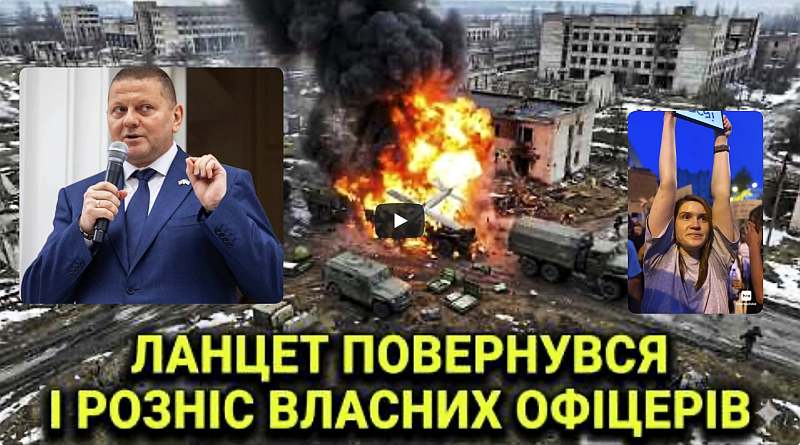

General Zaluzhnyi is absolutely right a thousand times when he emphasizes the thesis, “technology is the decisive factor in modern warfare.”
Here is a fresh example of how cyber technologies can even turn the tide of our entire war for independence.
Recently, a video was released on YouTube detailing how Ukrainian specialists not only intercepted the control of a Moscovite Lancet (a very nasty thing, military people know), but turned it around and forced it to hit its own command vehicle “Tiger” – already deep in the rear of the Russian forces.
The story so far seems almost sensational. Because the scaling of such practices could radically change the direction of the front line, in our favor.
But first, let’s analyze what actually happened and what might happen next.
As a specialist in cyber technologies, two points in this case immediately interested me.
First: the encryption of the “operator-drone” communication channel.
The channel is encrypted, so quickly decrypting it requires not just deep knowledge of cryptography (algorithm, protocol, key length, etc.), but also the availability of appropriate “tools” for super-fast decryption. Literally within minutes. The video provides data on how many minutes it took Ukrainian specialists and how many months they prepared for this. But the very fact of breaking the encrypted channel “on the fly” (both literally and figuratively) is a major breakthrough and the result of successful investments in R&D.
Second point: authentication of access to the UAV after successfully intercepting the control channel. This also requires a large volume of practical knowledge and further research (same R&D) on the system of identification, authentication, and authorization of remote access to the device.
Both these points – cryptography and authentication systems – are purely “cyber”, even cyber science. The success of the case was also facilitated by deep knowledge in the field of electronic warfare and radio technologies, but without the cyber component, it wouldn’t have worked. Jamming frequencies is one thing, but decrypting the channel and fully intercepting control is a completely different level.
If the success of this case was not an accident or a lucky coincidence of favorable factors, it could become exactly the moment of technological breakthrough that Zaluzhnyi was talking about. And this is where problems might arise.
For a tactical successful incident to become a strategic technological advantage in war, a “systematic approach” is needed. Fundamental, large-scale, manageable. Across all the Armed Forces and all defense forces, not just within specific units. Those same Western partners should know whom to contact in the Armed Forces to transfer those cutting-edge cryptographic tools and technologies to our army. Because in most countries of the world, cryptography is a licensed activity and is strictly controlled as a dual-use or military-purpose technology.
Therefore, a systematic implementation of positive practices requires an organizational structure like Cyber Forces. A single entity focused on top-level technological tasks, capable of scaling breakthrough solutions. And which coordinates the activities of all cyber units of the Defense Forces.
Back in August 2021, Zelensky issued a Decree on the Creation of Cyber Forces — supposed to be within 6 months. More than 5 years have passed, yet Ukraine still does not have Cyber Forces. Although the Law on Cyber Forces was voted by the Rada in October 2025 in the first reading, everything suddenly stalled in March 2026. This happened due to a well-known deputy who blocked the bill from being voted on in the second reading. 800 pages of amendments—this is blatant and obvious sabotage.
Yes, I know, the bill is somewhat flawed, with obvious future issues; I criticized it myself at one point. And it could have been done without a separate law at all.
But ultimately, some decisions need to be made to officially create Cyber Forces — whether with the law or without. Somehow.
Because the situation currently looks like the saying: “Swam and swam, and drowned near the shore.” Somehow a long and complex path was chosen to create Cyber Forces: hard to swim against the current, but almost there now. For me, for example, it’s just frustrating to have spent 5+ years and massive efforts on coordination among dozens of agencies with often opposing interests.
By the way, an interesting point: the Ministry of Defense and Mykhailo Fedorov personally officially approved the current version of the Cyber Forces bill for the second reading. And this version was supported by all other relevant structures and special services.
Yet, despite all this, the final adoption of the bill is deliberately blocked by a deputy who is unofficially (but clearly) guided by the same Fedorov. So what game is the young Minister of Defense playing? And most importantly, in whose interests?
Returning to the Lancet and its interception, it’s truly a brilliant victory. The result of long and highly skilled work by both cyber specialists and drone operators, EW specialists, intelligence, assault troops, infantry — everyone involved.
Now the important thing is somehow not to squander this undeniably outstanding success.
