
On March 7, the Rocket Forces and Artillery units of the Ground Forces, together with the Aviation of the Air Force of the Armed Forces of Ukraine, struck the storage, preparation, and launch sites of “Shaheds” in the area of Donetsk airport.
As reported by the General Staff, a massive fire and secondary detonation were recorded after the strike.
Logic of the Object: Repair and Concreting of DAP
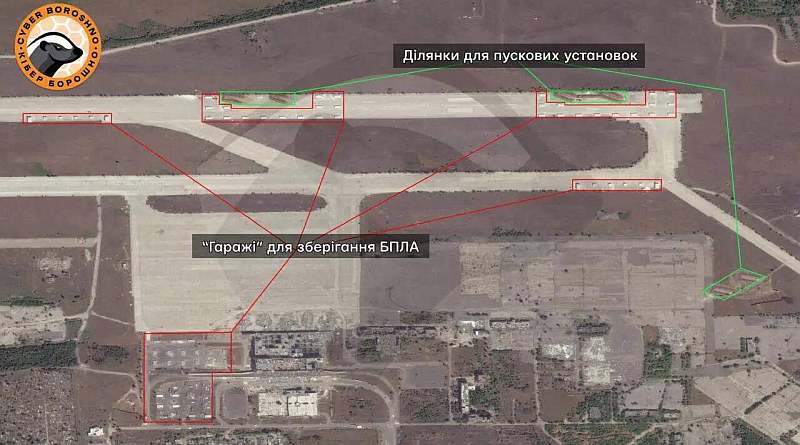
Active commotion in the DAP area began around September-October 2025. The scale of works clearly indicated that this was not the restoration of the airport for aviation. The Russians were actively pouring concrete into the surviving underground communications, hangars, and terminal basements. The main goal was to create workshops protected from shelling for the assembly, maintenance, and final programming of drones right “at the forefront.”
The Russians hardly touched the runway (ZPS); it was completely destroyed back in 2014-2015. But they carefully cleared several taxiway sections to quickly deploy mobile “Shahed” catapults based on trucks. They also replaced some slabs to allow heavy vehicles access to new warehouses. We observed every bag of cement brought in — but the target was not the construction crews, rather what was being built.
Preventive Work and Enemy Reaction
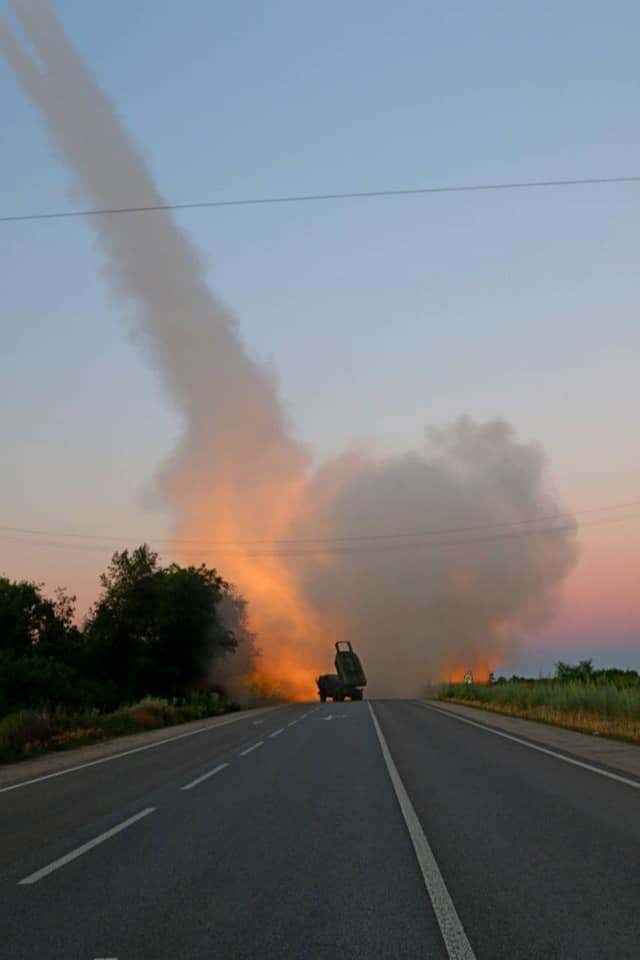
Intelligence and pilots in the responsibility zone detected the arrival of the first large batches of containers, and the first round took place: striking the old terminal area and underground fuel storage facilities. Mainly HIMARS (GMLRS) were used. As a result, losses were inflicted, and work was temporarily halted.
Then the Russians drew a fatal conclusion for themselves and began to dig deeper into the concrete. They sincerely hoped that an ordinary missile wouldn’t reach them there. But the logic is simple: if you bury hundreds of liters of fuel and combat parts for drones underground, sooner or later this volume will work against you and bury everything under the same concrete.
Operational Motivation: Why Did They Choose This Location?
The reasons for their fierce hold on the DAP are rooted in tactics. They planned a rapid breakthrough to our fortress belt and the new SOU defense line. To destroy bunkers, artillery positions, fortified buildings, disrupt relays and communication bridges, they urgently needed a solution. With insufficient high-precision weaponry, lacking a HIMARS equivalent, “Shaheds” came into play — thermobaric warheads with 50–90 kg payloads, offering enough accuracy to strike buildings, pilot positions, or antenna groups.
55 km to the line is primarily about speed. It’s not a few hours from Crimea, where we receive azimuth beforehand, track targets acoustically, visually, and via radar.
In such cases, we manage to deploy mobile groups, send helicopters and fighters for interception, bring in several “Gepards”, create a concentration of fire, or use a missile from an air defense system in extreme cases.
Here, everything is too close — there’s neither time nor a sterile territory to advance air defense closer. A takeoff and a quick dagger strike. Aviation can’t be sent for such interceptions; it’s too close to the line of contact — it’s easy to receive missiles from mobile air defenses.
This is a very specific challenge, with few ways for us to respond using traditional methods. Essentially, a strategic tool became tactical.
Work on Bunkers
Why did the Russians risk establishing a “Shaheds” base 55 km from the LBZ? It’s within the GMLRS radius. Because for them, the DAP is an ideal junkyard landscape, easy to hide in among thousands of tons of crushed concrete. They thought we wouldn’t waste expensive ATACMS and Storm Shadows on “ruins”. But when the object posed a direct threat to our strategic defense, we precisely neutralized this base — using unitary ATACMS and several SCALP/Storm Shadows without hesitation.
The ballistics were monoblock, to pierce slabs and terminal ceilings, where they had set up their “solder stations”, warehouses, and laptops with flight tasks.
The Storm Shadows acted like true surgeons: their Broach warhead works in two stages — the first charge pierces a hole in the concrete, and the second detonates directly inside the underground bunkers, incinerating everything.
Mathematics of Losses and Systemic Effect
Judging by the detonations, dispersals, and hours-long fires, it was all there at once. Just the material part in the form of a month’s supply of “Shaheds” for the active phase (approximately 200–300 units) is already about $6–10 million just for the gliders, engines, and spare parts. The technological sector suffered even more: professional soldering stations JBC or Weller, digital microscopes, oscilloscopes, programmers, protected Toughbook laptops, and specific communication tools they try to use instead of Starlink — setting up such a “branch” costs from $3 to $5 million.
But the main thing is the specialists. The removal from the game of the commissioning team of experienced engineers who program drones just before launch, adapting routes to our new posts — this is a loss that cannot be quickly compensated with money. It is an intellectual void that they will take months to fill.
Add to this the engineering infrastructure: concrete pouring, basement sealing, complex ventilation systems, and protected communication lines that were severely damaged by the fire and detonations — this is another $2–3 million.
But here it’s not about the money — we saw a threat, outlined a frontline base, and removed it months ahead.
| Simultaneously and synchronously, operations were conducted on Tochmash in Donetsk, knocking out an ammunition depot (the NRK workshop came as a bonus), and a large logistics hub in Mariupol.
In both locations, we saw strong fires and heavy detonations, confirming the success of the strikes. Russia is currently actively preparing for the spring-summer campaign, and we are striking preemptively — destroying ammunition straight on the ground and burning out frontline UAV bases. The enemy wanted to create an advantage at a short distance, but instead, received a complete blackout of the entire infrastructure with Western precision weapons. Judging by the number of launches — the western wind blew into our arsenals again. |
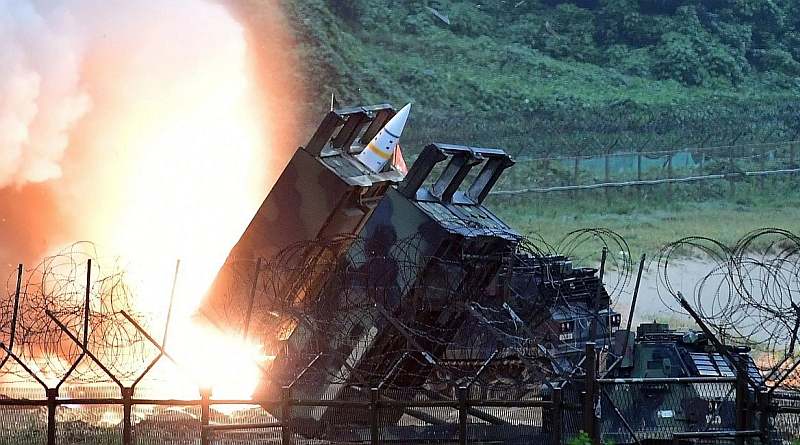
On the cover: Launch of the ATACMS missile. Illustrative photo: Defense Express
