
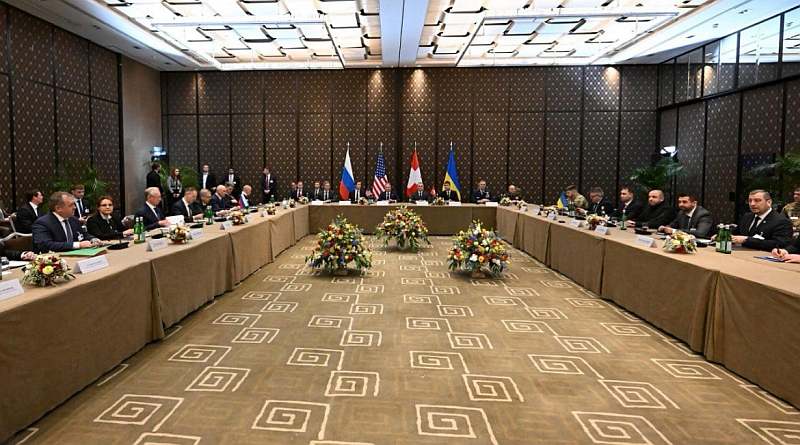

On Swiss territory, difficult but important negotiations took place between the delegations of Ukraine and Russia. Although no specifics have yet been announced regarding their results, the overall atmosphere is characterized as constructive, and even terms about substantial progress during the international dialogue round are being mentioned.
Interestingly, the head of the Russian delegation, Medinsky, even held a separate meeting with the Ukrainian side without American mediators. The details of the talks are not disclosed, but this procedural moment draws attention, as it seems the delegations left some things unsaid in the presence of Trump’s mediators.
Probably the most encouraging aspect for the peace party is the announcement of a new round of negotiations to be held in Switzerland in the near future. In all other respects, no progress in terms of formalizing agreements on a ceasefire or peace is noted. Some sources boldly characterize Geneva as a failed round.
One of the problems of the Geneva stage of the peace process is the US’s biased position. Americans are interested in strengthening President Trump’s image as a peacemaker. But the drive for quick success, as was the case with Gaza, Cambodia, or DR Congo, does not apply in the event of the Russian invasion of Ukraine. Moscow is violating the fundamental provisions of the UN Charter, undermining principles of good neighborly relations on the world stage, and yet Trump is still favorable to Putin. Evaluations are circulating suggesting Washington is mainly pressuring Kyiv. Tools of coercion are being used to force Ukraine to accept a painful compromise.
Is this aspect part of what the Kremlin calls the “spirit of Anchorage,” where the US ceases to be neutral and pushes for a deal with obvious asymmetries not in Ukraine’s favor, while Ukraine, unlike Russia, is part of the Western world. The Ukrainian people’s feat is not only the defense of Europe and its values but also a point of reassembly for the European and Euro-Atlantic community. Here, the Americans should press Moscow, not the other way around.
Instead, the Russian Federation interprets the “spirit of Anchorage” as big power diplomacy, which, like in Munich in 1938, divides foreign territories. Putin and his diplomats led by Lavrov are pushing their vision for the Donbas solution. This involves the withdrawal of Ukrainian troops from its territory and the transfer of the region under Russian control. However, a fundamental point is the equivalent withdrawal of Russian occupying forces from the territories of Kharkiv, Sumy, Zaporizhzhia, Dnipropetrovsk regions and retreat to the territories of the Donetsk region.
Who and how will take control of this gray zone is an important issue in the negotiations, as well as the control over the implementation of the ceasefire regime.
Attention should be focused on the aspect of binding the territorial issue to the lifting of sanctions from Moscow and the launch of joint US-Russian economic megaprojects totaling $12 trillion USD. The sum is astronomical, and it would seem, for Putin, considering such prospects, it would have long made sense to end the invasion and allow business to launch the stagnant Russian economy.
This approach could remove accusations that Geneva is a “zero-sum game.” However, something strongly prevents Putin from ending the war and moving to peaceful coexistence. This complexity lies in the flawed ideology of Putinism, designed for terror and subjugation of Europe, including Ukraine.
