
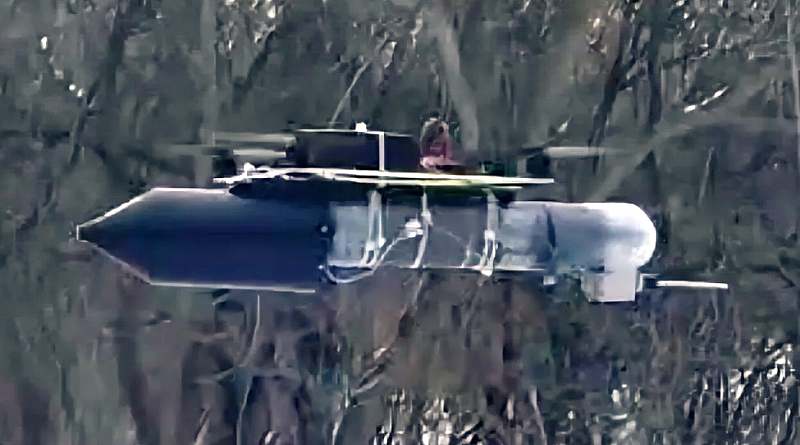
Alexander Kovalenko / Obozrevatel
The first Russian FPV drones on fiber optics have reached the northern outskirts of Kharkiv for the first time. What danger do these means of terror pose to the regional center, how to fight them, and why is the enemy using them now? Let’s try to figure it out.
Risk Zone
To understand the risk zone, we first need to determine at what distances the enemy can use FPV drones on fiber optics. And here comes the extremely unpleasant news for the administrations of those cities located up to 40 km from the line of combat or the border with Russia. Today, these drones have the ability to cover precisely this distance, although there are very rare instances with fiber optic spools of 50 km.
Now, let’s answer the question of how far Kharkiv is from the border with the RF or from the nearest line of contact. It’s 25 km (Nekhoteyevka, Belgorod region, RF) and 20 km (temporarily occupied Hlyboke).
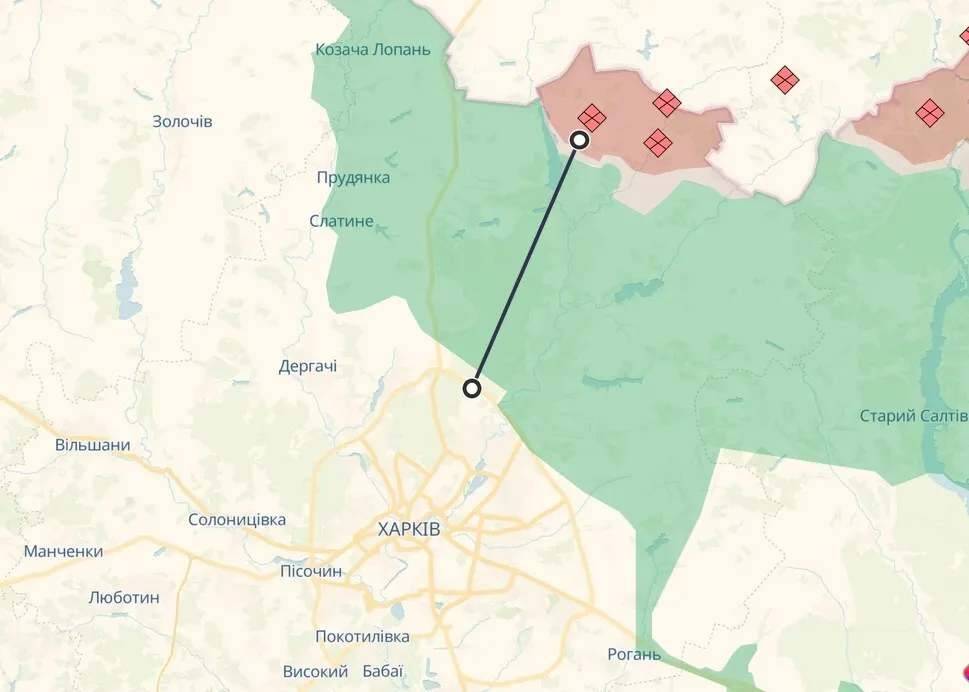
Therefore, ROV operators, even with a 10 km safety buffer, could have long allowed themselves to attack the northern outskirts of Kharkiv, starting to terrorize Northern Saltivka and more.
But why didn’t they do it earlier, using other means of terror?
New Terror Tasks
In my opinion, there are several reasons for this, each with accompanying factors.
Speaking of the technical aspect, despite the proximity to the Russian border and the LBC, we are talking about quite lively areas, and therefore the chance of losing a less maneuverable drone due to fiber optic damage is much higher than in the field conditions of the front line.
However, in the northern Kharkiv region, in the area of Vovchansk, a stalemate situation has long arisen. Having launched an offensive on Vovchansk in May 2024 (one of whose goals was to break through to Velykyi Burluk and reach the rear of the Kupiansk group of the Ukrainian Defense Forces), Russian troops have been bogged down in this small town for almost two years now!
The Vovchansk operation failed miserably, and the flank at Liptsi is even worse — it has fallen into convulsive stagnation for the “Belgorod” troop grouping.
Because of this, the Russian occupying forces (ROF) are trying to reduce the cost of terrorizing Kharkiv by making it round-the-clock, as well as cutting logistics along major routes and lateral roads.
The task for the command of the occupying forces is essentially to turn Kharkiv into Kherson in the context of terror, organizing constant hunts for civilians and military personnel on the roads around the regional center and on the streets of the city itself.
Threat and Counteraction
Using the example of the heroic and suffering Kherson, we know what it is — terrorizing civilians not just with artillery shelling and missile strikes, but with the use of low-visibility FPV drones. Moreover, the situation for Kherson is worsened by the fact that the distance from the potential positions of ROF operators to the city itself is less than 5 km, and there’s no need for fiber optics there.
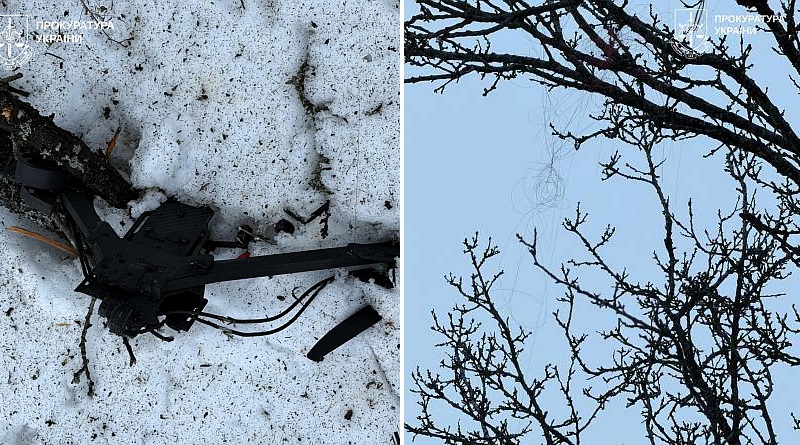
On the other hand, regular FPV drones can be suppressed by electronic warfare, but the problem with countering fiber optic ones is their protection from electronic interference.
It is also difficult to detect such small objects by classical methods, although there is a set of measures that warn of danger. Additionally, acoustic detection means can be actively used, especially for those locations where the enemy has to cover not 5 km, but 20 or more.
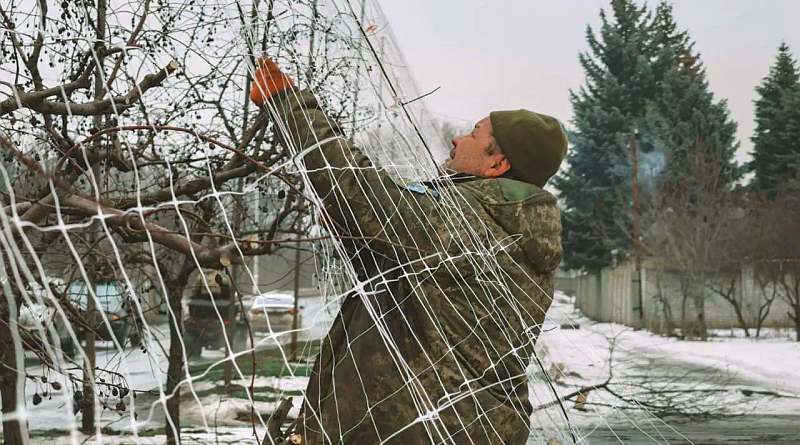
However, as of today, the most effective method of counteraction is passive protection along roads and streets at risk, specifically — nets.
There is no absolute method that provides a 100% guarantee of safety from FPV drones, but net-based passive protection stretched along roads in risk zones, including in cities themselves, is a working scheme that has proven its effectiveness over time.
However, the question arises: why don’t all roads and streets in cities located within 40 km of the Russia border or the line of engagement, or even 20-25 km away, have long-established passive net protection?
Besides Kharkiv, the appearance of FPV drones in Zaporizhzhia, Sumy, Izium, and other cities that a fiber optic drone can reach is a matter of time. How many of these settlements have at least such elementary protection along the roads leading to them and net-covered main streets? Unfortunately, this question is rhetorical.
Conclusions
The Russian occupation forces, as always, will compensate for their failures in the combat zone by catalyzing terror against the civilian population.
Unfortunately, there is no completely effective method to counter this terror. Patrols with smoothbore shotguns can be posted as mobile fire groups, and counter-battery warfare can be conducted in the areas where drone operators are located, but none of this provides a 100% guarantee of protection.
However, only the comprehensive use of all methods, both active and passive, especially the installation of nets along roads, can minimize the damage caused by FPV drones. If these passive protection methods are not scaled up now, which should have been done yesterday in cities at risk, tomorrow will be too late.
The material is published as part of a joint project between OBOZ.UA and the “Information Resistance” group.
The cover features an illustrative photo: social networks of the occupiers
