
Elias Forneris, RUSI / Translation iPress
RUSI Research Leader Elias Forneris believes that Europe is facing a serious threat from Russia, and the parallels with the pre-war 1930s are more than appropriate. Despite part of the political elite already recognizing the danger, the broader public and most Western governments have yet to transition to “war thinking.” Effective deterrence of the aggressor requires mobilization of the entire society—honest communication to citizens about the threat, consolidation of allies, and decisive political leadership. According to the author, deterrence is an ungrateful but most important task: if it works, we will never know what catastrophe was avoided.
In response to the threat of conflict with Russia, as during the great wars of the 20th century, Europe is showing new determination. Comparisons between preparations for previous world wars and today are not exaggerated. It is worth seeking guidance in past international conflicts. World War II ended just 80 years ago and still provides rich material for reflection. An elderly man recently reminded the author of this article that war is living memory; as an infant, he was injured by a bomb that fell on his house in London during the V-Weapons campaign of 1944–1945. In early December, NATO Secretary General Mark Rutte publicly warned: “We must be prepared for a war of the scale our grandparents and great-grandparents experienced.” American intelligence has also found that Putin has not abandoned plans to annex Ukraine and neighboring European territories. Meanwhile, Russia continues to conduct operations aimed at dividing and discrediting European societies. Europe is on the brink of a “storm.” To confront it, societal response and leadership capable of strengthening the alliance are needed.
Mobilization of Society
A few weeks ago, the Royal United Services Institute sent a British delegation to the Institut Montaigne in Paris to participate in a conference on “European Defense Cooperation.” High-ranking European diplomats, defense experts, and industry leaders discussed a “whole society” response to the threat from Russia. Behind closed doors, the atmosphere was grim, although the delegates demonstrated extraordinary determination, especially those from Northern and Eastern Europe. The delegates operated under the assumption that even if Europe is not formally at war with Russia, it is at least in a pre-war phase of confrontation. They concluded that European states cannot continue to act as if they are living in peacetime, a conclusion supported by NATO Secretary General Mark Rutte, who called for a shift to “wartime thinking.” What can Western Europe retain from its preparations for the last world war? And what changes must it undergo to deter Russia?
The common belief is that the United Kingdom was entirely inactive on the eve of World War II. Although the British political leadership in the 1930s indeed sought to appease the aggressor or delay the war, paying a high price for it, at least a minority of energetic political elite figures were extremely vigilant about the threat from Nazi Germany. Member of Parliament Winston Churchill devoted his “wilderness years” to unpopular speeches advocating for the rearmament of the United Kingdom and a firm stance on Germany. As early as November 1932, he warned that “every concession [to Germany]… was immediately followed by a new demand… The demand now is that Germany be allowed to rearm. Don’t be deceived.” Churchill’s biographer, Andrew Roberts, described how the politician, outside the House of Commons, surrounded himself with “experts in their fields who warned about Germany’s military power and plans, as well as its military weakness,” including specialists from the Foreign Office, the Royal Air Force, the Committee of Imperial Defence, and several concerned politicians from France and Germany. However, by 1937, he had only two allies in Parliament.
Up until 1938, an increasing group of British elite members supported Churchill or generally the policy of non-appeasement. The First Lord of the Admiralty Alfred Duff Cooper loudly left the government after the signing of the Munich Agreement. The young Anthony Eden and Harold Macmillan increasingly mobilized their like-minded supporters. In mid-September 1939, a scholar from Chatham House, Arnold Toynbee, contacted his French colleague to warn: “If France and Great Britain do not unite into one country, sooner or later Europe will unite in the form of German domination over our two states.” Toynbee, along with the Frenchmen Étienne Dennery and Emmanuel Monique, laid the foundation for an extraordinary but little-known proposal by Great Britain to unite with France on June 16, 1940. The agreement, brokered by Churchill and Charles de Gaulle, provided that “France and Great Britain will no longer be two nations but will become one Franco-British union… [with] common bodies of defense, foreign, financial, and economic policy. Every citizen of France will immediately obtain British citizenship, and every British subject will become a citizen of France.” By that time, it was already too late, and the project was shelved when Marshal Philippe Pétain took power in France that same day. Hence, Great Britain was not entirely frozen in the 1930s, but its preparation proved barely enough to ward off the German invasion in 1940–1941. Meanwhile, much of Western Europe fell under the control of the Axis powers.
Today in Western Europe, there is an active minority—a few political leaders and part of the foreign policy establishment—calling for containing Russia. The Chief of the Defence Staff of the United Kingdom, Sir Richard Knighton, told the RUSI audience that Britain “needs a nationwide response… the Russian leadership has made it clear that it wishes to challenge, constrain, divide, and ultimately destroy NATO… While the price of peace may be rising, the cost of strong deterrence is still much less than the cost of war.” The head of the British Secret Intelligence Service, Blaise Metreveli, stated on the same day: “Russia is testing us in the gray zone, employing tactics that almost reach the threshold of war.” Regarding the perception of threat, today Western Europe is probably in a better position than in 1938 or early 1939. Perhaps we have retained some of the wisdom gained from previous world wars.
However, despite some awareness of the threat, Western Europe has not yet shifted to a “war-thinking” mode to respond to it, and much of public opinion is unaware of the approaching storm. In France, the political elite is occupied with minor pension system reforms and budget adjustments, blissfully unaware or consciously ignoring that the stability of the system itself is at stake. Delegates from the Institut Montaigne concluded that for Europe to act at a societal level, governments must first inform the public of the threat and develop a joint European stance. Churchill’s father, Lord Randolph, tirelessly repeated: “Trust the people.” In a democratic system, trusting the people means telling them the truth. Without causing panic, governments should honestly explain to citizens the threat from Russia, teach them to recognize disinformation, and form expectations on how they can help in case of conflict.
Where is our Churchill?
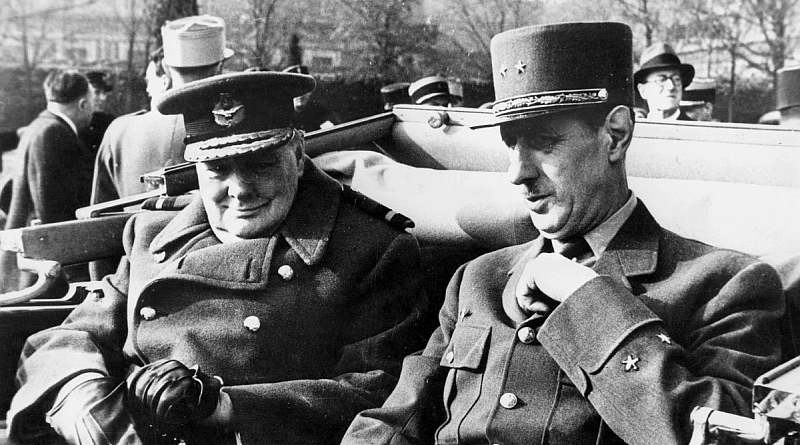
Last year, diplomatic meetings in Europe often ended with whispers or sighs: what if NATO’s political leaders are not unanimous? Interestingly, both de Gaulle and Churchill had similar concerns about transatlantic relations in the early 1940s. De Gaulle aimed to establish a French government-in-exile in London, but was disappointed by Franklin Roosevelt’s refusal to support him and the continued U.S. cooperation with the Vichy regime. De Gaulle maintained his stance until the liberation in 1944 and was ultimately justified in his resistance from abroad. Churchill understood that without the U.S., much of Western Europe could fall under German control. Therefore, he used all his diplomatic skills to persuade Roosevelt to side with Britain and made five dangerous trips to the U.S. during the war, where he stayed at the White House for weeks.
Today, the Euro-Atlantic alliance lacks its Churchill. At the same time, leaders like de Gaulle and Volodymyr Zelensky have shown that Churchill-like figures can emerge from the periphery—from smaller nations or severely weakened positions. Such figures can also appear at a later stage of a war: during World War I, Georges Clemenceau became the French Prime Minister at the end of 1917, when the conflict had already lasted over three years. Clemenceau was an elderly man, a radical politician considered past his prime, who took a simple stance: “I also want peace… Pleading for peace, we will not be able to suppress Prussian militarism… Domestic policy: I make war. Foreign policy: I make war. I always make war.” When people set an example, sources of enthusiasm can be unexpected.
Immeasurable success
If the threat from Russia is taken seriously, what would a war with them look like? If war is avoided, we will never know. Deterrence is a thankless task crowned with immeasurable success. As Sir Knighton noted: “How much [deterrence] is enough?… Answering this question is almost impossible, except in hindsight. But if we are wrong, the price could be enormous.” On the other hand, a failure of deterrence will lead to war or local conflicts—unlike the two previous world wars.
As long as Europe is not in a state of total war, every minute should be used for preparation. Political leaders in Western Europe may be more aware of the threat of war than they were in the 1930s but only slightly. Awareness will be pointless unless accompanied by concrete mobilization. During the Great War, the head of the lower house of the French parliament, Paul Deschanel, posed a question similar to today’s: “Was the lesson of 1870 useful? … Our foremost duty is to work for the eradication of war, but in the meantime, we must anticipate it and prepare accordingly. Preparing for it does not mean desiring it.” Political leaders must make defense a priority on the agenda and inform public opinion accordingly. If five or ten years from now France is once again discussing pension reform, Europe will know it has survived the storm.
