
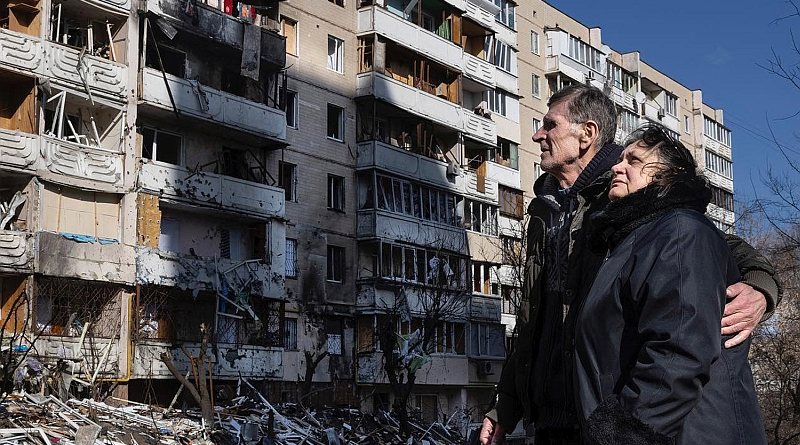

The fourth anniversary of the Russian invasion of Ukraine is approaching. Few within Russia are genuinely interested in whether Putin’s mega-project will be successful or not. The dictatorial regime has plunged the country’s population into a state of apathy and deep stupor, systematically killing hopes for a peaceful existence.
Within the ruling elite, there have been problems with formulating the reasons for the war, where the aggressor country has sunk to the level of recruiting cannon fodder. Recruiting Russian citizens has become almost a lost cause, as the figure of 1,230,000 personnel losses sobers up anyone except the frigid dictator Putin. The latter, by the way, truly pursues a policy of genocide against Ukrainians through cold, depriving the civilian population of access to heat and electricity during weeks of severe frosts. This is what the strategy of terrorist warfare looks like after failing to achieve reasonable results at the front.
Attempts to explain the reasons for the invasion have dissipated. After so many years of armed aggression, its motives might have seemed obvious. But the Kremlin has nothing behind it other than a bloodthirsty desire for profit and a war of conquest.
Putin’s propaganda is scrambling to rewrite school textbooks to sell the “Alpha” generation fake fabrications about the reasons for the Putin war. Putin’s aide Medinsky is in a bad position. This mutant believes, like a true Orwell fan, that rewriting history textbooks year after year, considering political fluctuations, is neither dishonorable nor unnecessary. It’s just phenomenal nonsense when now, in January 2026, this politician is putting forth a hypothetical version of the reasons for the bloodiest invasion.
“Imagine for a minute that Ukraine joins NATO. Then NATO troops would threaten the security of our entire country. If war were provoked, then Russia would be fighting all of NATO. This is the death of all civilization,” Medinsky states.
But he looks like an absolute liar, as NATO troops have long been at Russia’s borders and are themselves very much avoiding any confrontation with the Russian army. In the current geopolitical conditions, NATO’s philosophy and all Euro-Atlanticism are being re-evaluated, especially in light of the situation, specifically the Greenland fiasco. While Kremlin propaganda inflated the Greenland story to whitewash Putin’s irredentism and gloat over an almost war within NATO, it became clear: they are cutting the branch they’re sitting on.
Firstly, Trump does not intend to resolve the Greenland issue by force and is looking for other mechanisms, albeit not the most friendly, but not overtly combative. Here, Putin with his “SMO” simply landed himself in a mess. Secondly, Moscow proclaimed the incapacity of NATO, its fragmentation, and disarray within its ranks. It turns out the once-demonic Alliance is entirely occupied with internal problems and definitely cannot be a military threat to Russia. Meanwhile, Trump’s policy, praised by Russian ideologists, actually carries the beginnings of Russia’s loss of positions in the Arctic and, in the future, even a Northern war.
Will the realization of such a scenario be a shock for ordinary Russians? It seems it will because if your country follows a philosophy of devaluing everything and ignores international law, in the end, it itself will end up on the menu.
Over 70% of Russians already want a peaceful resolution to the Ukrainian issue. No more than a quarter of respondents believe in Kyiv’s capitulation… The excessive cost of the war leads to a situation where any end to it will be recognized as a better solution than its further continuation. The announcement of the war’s end “at any moment” will be enthusiastically met by the Russian population, exhausted by hopelessness. But the obstacle remains the fate of Putin’s regime. It has merged and intertwined with bloodshed, feeds on fears and deaths, speculates on external threats, although, unlikely, worse scenarios than endless and equally senseless military days of the final phase of aggression are possible.
Illustrative photo from open sources
