
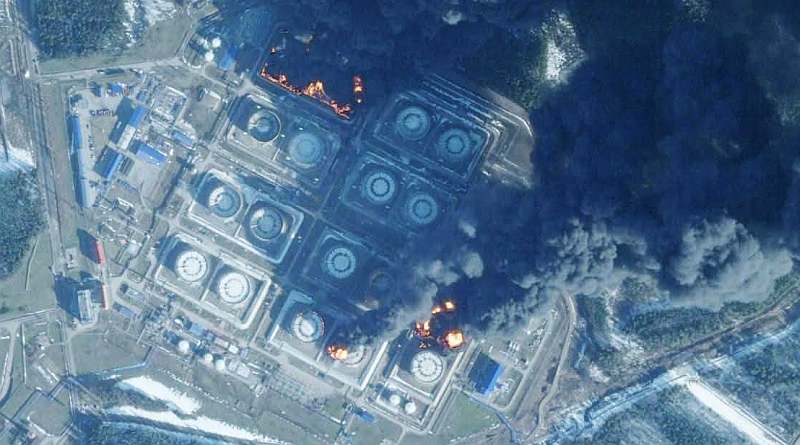

Why Primorsk became the perfect finale for Russia’s “ice season.”
Today’s strike on Primorsk shows that we are strategically doing everything right.
In January, Russia’s Baltic oil and gas segment set an export record of 12.7 million tons of crude oil. In February, due to abnormal ice formation, Primorsk was left untouched, as the overall decline across the Baltic was 15-20%, and exports specifically from Primorsk fell to a record 40-50%.
However, strikes were carried out on Ust-Luga and the line to it in the Bryansk region. Ust-Luga is an important technological station, and the impact on Novatek’s large cryogenic installations significantly reduced processing capabilities.
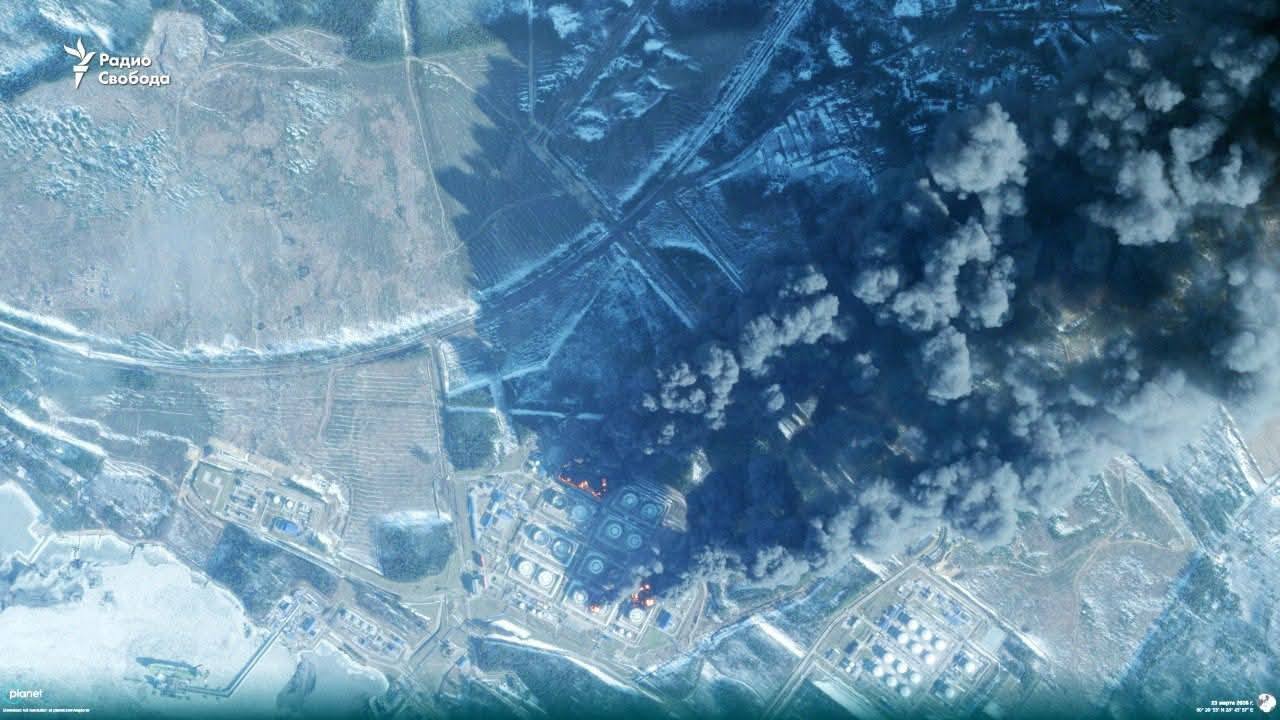
And now, as the ice melts and events in Iran allow the swamps to earn at least somewhat (although discounts on Urals grade have not been canceled), the strike hit Primorsk. The port, which has huge reservoirs (at least one was definitely destroyed overnight) and can export a million barrels a day, will now significantly reduce its capacity. This will also create a fuel shortage for the western regions and the “North” military group in general.
The logic is simple: we are not just hitting where we can reach; we are disabling their capabilities precisely when they are most needed by the enemy.
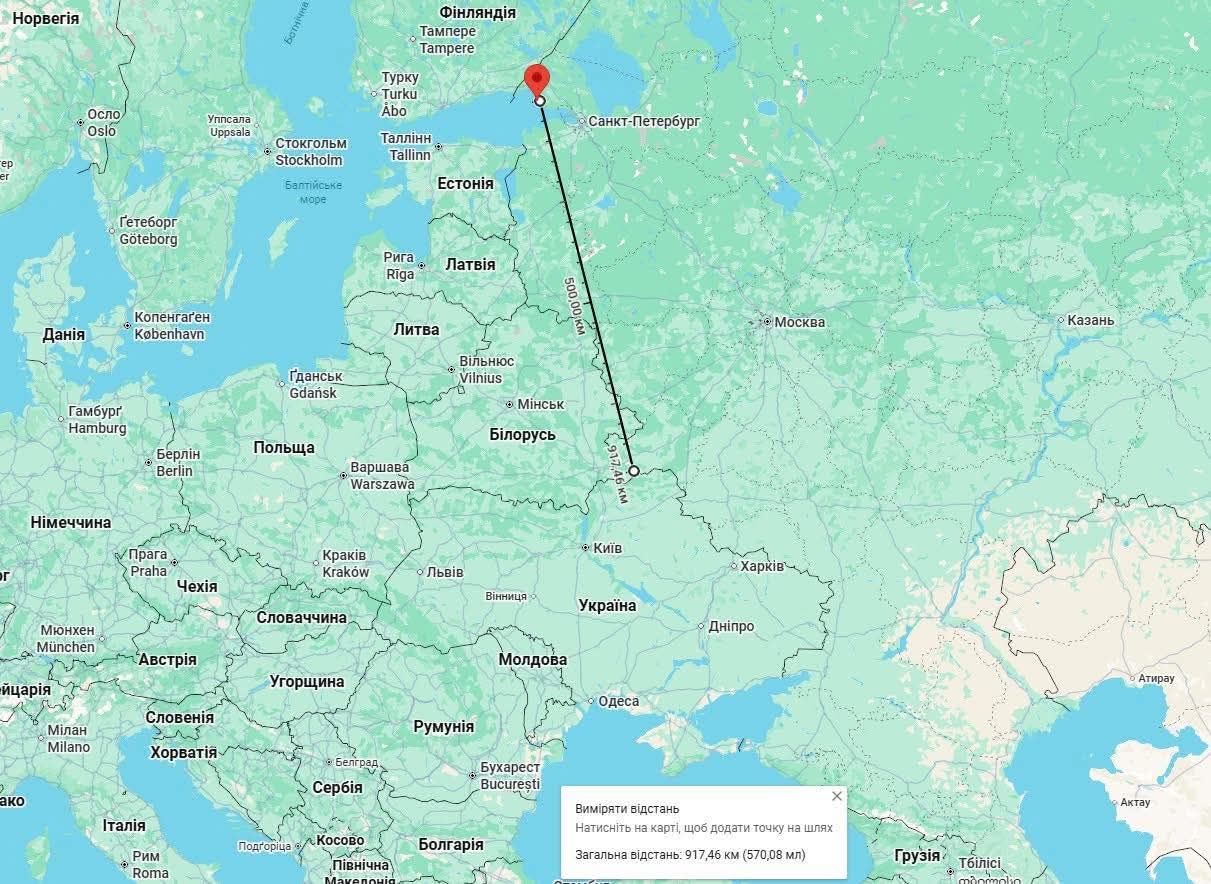
1,000 km is no longer a distance; it’s a verdict for their economic stability in the Baltic.
Things will get even more interesting. What do you think, which terminal is next in the “red zone” – Vysotsk or Ust-Luga again? 😉

Already yesterday evening, it became clear that today would not be calm. A number of reasons emerged to gather a negotiation mosaic following the meeting in the USA, which concluded with another breakthrough in bridging positions and reducing distances in the context of deepening optimism, for which we especially thank our American partners.
The main thing: amid schizophrenic talks of potentially easing sanctions against Russia, the Ukrainian side demonstrated that there’s no need for this nonsense. And in the most explicit form.
I think it’s time to introduce tennis-like terminology, such as “Grand Slam objects,” “object – thousands,” “tournament – 500,” etc.
Today, the CSO “A” of the SBU, as part of a joint operation with colleagues from other Ukrainian Defense Forces structures, “captured” another “Grand Slam” element – hit the oil depot and oil infrastructure of “Transneft” in the port of Primorsk (Leningrad region). This is one of the essential points, failing the defense of which generals from air defense are surely being severely reprimanded now.
Let me remind you that exactly a month ago, CSO “A” (independently and with colleagues) hit:
• NPS “Kaleikino” near Almetyevsk (22/23.02.26);
• Objects in the port of Novorossiysk, including the oil depot “Sheskharis” (01/02.03.26);
• The oil hub in Tikhoretsk (11/12.03.23);
• And now – the oil depot in the port of Primorsk (22/23.03.26).
What should be highlighted here?
Firstly, the density of events is unimaginable. Every 10 days, we deliberately reach a super-strategic object. And in a continental range from the Baltic to deep Volga to the Black Sea.
This is not just beautifully setting fire to barrels of oil; it is working against the system that the Putin regime parasitizes on. And everyone sees it. And everyone sees that Russia can do nothing about it. Except perhaps to shell another ambulance, passenger train, or kill a pensioner on a bicycle.
Let us not forget that under pressure this entire time are also the oil hubs in Volgograd, Saratov, and Samara. It’s a matter of (comparatively little) time before Ukraine’s strike capabilities so exceed air defense capabilities outside of Moscow that the degradation of the oil infrastructure will become catastrophic.
Secondly, the Baltic is a key export point for Russian oil and oil products. The ports of Primorsk, Ust-Luga, Vysotsk, and Saint Petersburg handle about half of the crude oil exports. India and Turkey particularly benefit here, with China being supported both directly and indirectly.
The SBU reached the port of Primorsk on September 12, 2025. Two weeks earlier, a facility of “Novatek” in Ust-Luga was beautifully on fire.
However, the Baltic ports as a whole remain a difficult target because they are within the defense zone of Saint Petersburg. And, for a moment, considerate drones are moving from Bryansk over all the infrastructure supposedly meant to repel the aerial attacks of the dreaded NATO.
The beauty is that last night the operation to breach the enemy’s layered air defenses could be observed practically in real-time.
The first air raid warnings in the Leningrad region were sounded around 16:00. The port was struck around 03:45. During all this time, local authorities reported downed UAVs in various parts of the region. Restrictions were lifted by 11:00. This is not about random luck. Ukraine aimed and pierced through. Apparently, in preparation for this mission, Moscow’s air defenses were bolstered for several days to keep the Russians on edge. Russia was not ready for the shift in focus from the Kuban to the Baltic.
Thirdly, Primorsk itself. It has two main components:
• The oil terminal (with storage of 920 thousand tons, including 18 tanks of 50K tons each), which receives crude oil from the “Baltic Pipeline System,”
• The transshipment base for oil products (240 thousand tons), connected to the main oil product pipelines from Yaroslavl and the “Kirishi Oil Refinery.” A pipeline from it also leads to the port of Vysotsk, home to “Lukoil.”
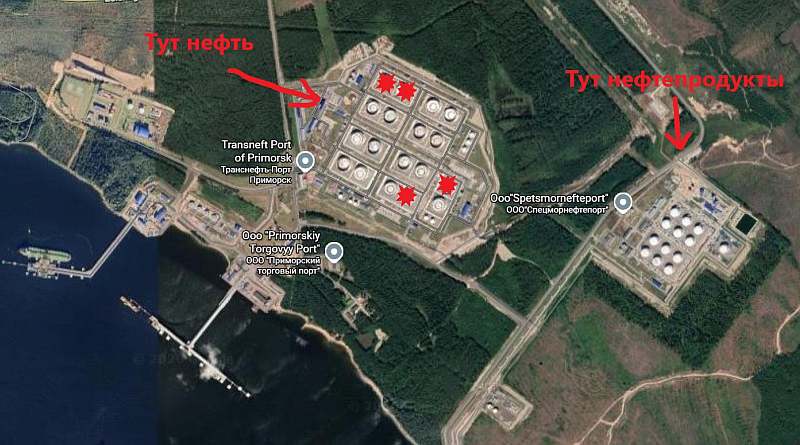
Both bases have autonomous infrastructure for transshipment to ships.
Preliminarily, three tanks of 50K tons of crude oil (and possibly a fourth) were hit in Primorsk. Damage to the transshipment infrastructure is being clarified.
The nuance of this port is its high turnover. It pumps about 60 times more crude oil than the capacity of its tank park. So it’s not a warehouse; it’s akin to a monstrous pump, which, roughly speaking, pumps its standard volume of oil five times a month.
About 20% of the capacity of this “pump” was lost in a single attack. How this will affect operations is in question. To maintain pace, the load on the remaining capacity will need to be increased. There is likely some reserve strength, but it is an abnormal mode. A decline is inevitable.
The experience of other sites shows that constructing a single 50K-ton tank takes a year. And here, there are at least three tanks. Russians will have to find some solutions.
But in 10 days, those benevolent drones might hit something strategic again…
Photo: Radio Svoboda
Copyright © 2021 RFE/RL, Inc. Reprinted with permission from Radio Free Europe/Radio Liberty
