
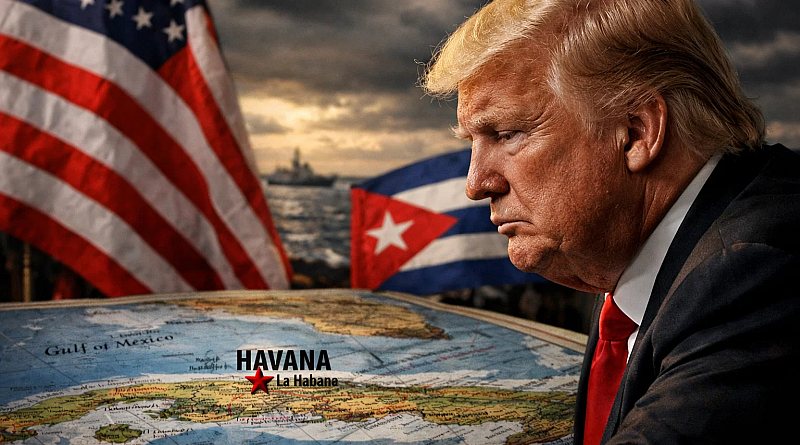

Developing the topic of whom the US might bomb for informational-therapeutic purposes.
On January 29, 2026, Trump issued the decree “Counteracting Threats from the Government of Cuba to the United States.”
The essence: Washington can impose additional tariffs on goods from countries supplying oil to Cuba. The goal: to change the policy of the Havana regime, which has become more vulnerable after being cut off from Venezuela.
Overall, the text resembles what Trump generates with and without occasion. However, this decree contains formulations that might hide an interesting story.
1. The Ukrainian track
Regarding Cuba, we largely maintain a neutrally positive inertia related to the Chernobyl topic (thousands of Ukrainian children received treatment and rehabilitation in Cuba), various Hemingway connections, and other nostalgic plots. But time brings its adjustments.
In 2014, Cuba supported Russia (not free of charge). After 2022, some uncertainty persisted for about a year. But in early March 2023, the head of the RF Security Council, Nikolai Patrushev, visited Cuba, and everything changed.
It is believed that the seeds of evil were sown in November 2022, when Cuban leader Miguel Díaz-Canel visited Russia (begging for help), and Patrushev then settled the details.
Cuba began supporting the RF on the international stage, and from the fall of 2023, there were reports of Cuban mercenaries in the Russian army.
Until the end of 2023, the Cuban Ministry of Foreign Affairs tried to deny these facts and even scolded the mercenaries, but in May 2024, Miguel Díaz-Canel, being in Moscow, publicly wished Putin to achieve the goals of the “SVO.”
October 2025 became pivotal.
Last fall saw a public discourse clash of “if Tomahawks – in Ukraine, then hazelnut – in Cuba.” A “Caribbean crisis” ensued on a minimal scale.
On October 6, 2025, Reuters disseminated information about a State Department letter dated 02.10.25 directing American diplomats to ensure a negative vote in the UN on the resolution to lift sanctions from Cuba.
One of the reasons: 5,000 Cuban mercenaries in the Russian occupation forces in Ukraine, making the Cubans the second-largest contingent after the North Koreans.
The timing of the publication of this information was not accidental.
On October 7-8, 2025, the State Duma and the Federation Council of the RF ratified the Intergovernmental Agreement on military cooperation with Cuba (effective from 15.10). It was signed back in March 2025 and matured for six months. Washington was not pleased.
On October 11, the Cuban Ministry of Foreign Affairs began furiously denying the mercenary story and asserting that Havana was not involved in the intervention. But that did not help.
Ukraine voted against the Cuban resolution for the first time. On October 29, Foreign Minister Andrey Sibiga announced the closure of Ukraine’s embassy in Cuba and the downgrading of diplomatic relations. Formally, the Cuban regime is considered hostile. If it faces consequences, we would welcome it. However, there’s a nuance: many Cubans join the Russian army out of poverty, and economic growth could stop this flow. For that, the regime needs to be replaced and sanctions should be lifted.
2. Trump and Bond
The motivating part of the U.S. “Cuban” decree from January 29 includes the following introduction:
“The Cuban government has undertaken extraordinary actions that harm and threaten the United States. The regime maintains ties with many hostile countries, transnational terrorist groups, and malevolent actors opposed to the U.S., including the Government of the Russian Federation…”
Further:
“…Cuba openly provides refuge to dangerous adversaries of the United States, inviting them to place complex military and intelligence facilities on its territory, which directly threaten U.S. national security. The largest Russian electronic intelligence facility is in Cuba, attempting to steal secret information that poses a national threat to the U.S…”
And the conclusion:
“…If the government of Cuba or another foreign state affected by this decree takes significant steps to address the state of emergency declared in this decree, and sufficiently aligns with the U.S. position on national security and foreign policy issues, I may amend this decree.”
In other words, Russian electronic intelligence (SIGINT) must leave Cuba, or else – tariffs.
The image of Russian radio tech spies is perfectly visualized for the public in the 17th Bond film “GoldenEye” (1995). Climax: Agent 007, played by Pierce Brosnan, fights the main villain in the dome of a top-secret Soviet spy antenna, the size of several football fields, disguised as a lake.
It is possible that the passages about Russia were inspired by this film, as in the general context, Russian spies appear as an unsavory target.
3. The Russian Track
Indeed, between 1962-1967, the Soviet electronic center “Lourdes” was built in Cuba (in the Havana suburbs). It operated within the GRU system, and later KGB. During Soviet times, it was staffed by up to 3,000 people. The USSR formally used it for free, gathering an unimaginable amount of information on the U.S. and the entire Western Hemisphere. Specifically, it effectively controlled electronic communications from NASA in Florida, signals from satellites, content from the naval base at Kings Bay (with Ohio-class SSBNs), the base at Guantanamo, the Eastern Test Range at Cape Canaveral, and other selected locations at a distance (believed to be) of up to 10,000 km.
In 1992, an agreement was concluded “On the presence of the Russian electronic center on the territory of the Republic of Cuba,” according to which rental fees were introduced, increasing to $200 million per year by 1996. Cuba was in a chronic crisis and needed the money.
But for Russia, it was also a difficult time. Moreover, in 2000, the U.S. House of Representatives passed an act as a form of pressure, prohibiting the restructuring of Russian debts until the withdrawal of the REC from Cuba. In 2001, Putin decided to close “Lourdes.” In 2002, the Russians formally left this center with the official motivation: there is no money, and now we are friends with the U.S. against terrorists. Many in Cuba perceived this as a betrayal.
A university of information technology was opened based on the remnants of the REC, where Chinese and North Korean officers unexpectedly began learning Spanish…
Time passed, the “prosperous 2000s.” In 2014, Putin, trying to counteract the negative impact of the invasion of Ukraine, toured Latin and South American countries. To be received in Cuba, Russia wrote off $32 billion of the “island of freedom’s” debts and counted an additional $3 billion as investments in the Cuban economy.
At that time, Russian federal media fervently claimed that Moscow was reviving “Lourdes,” although the Kremlin officially denied everything. They denied it in 2016 and again a couple more times. But Russian leaders, including those from the defense and security sectors, increasingly visited Cuba.
The REC “Lourdes” was a super-modern high-tech complex until the mid-1990s, for which unique equipment was specially manufactured in single copies. A significant part of it was dismantled, much had simply become outdated, and technology had advanced. Therefore, there was no theoretical need to “revive” “Lourdes” in its 1990s form. Serious modernization was necessary.
Such activity is hard to hide. But no heightened concern about Russian activities in Cuba in the context of espionage was observed for a long time until July 2023, when a publication unexpectedly appeared in the Russian outlet The Insider (more on this below). From it, we learn that in fact, Russians are active in Cuba.
The Insider provides detailed information about Russian military communication specialists, cryptographers, cybernetics experts from the GRU, missile experts, and military engineers who are disguised as diplomats in Cuba. It notes that specific Russians have been visible since 2007, when “Lourdes” was officially closed. The context is quite logical: due to technical innovations, there is no need for 3,000 specialists in Cuba; with adequate equipment, three dozen are sufficient. Here, these are the characters.
Media loyal to the Russian authorities still deny any specific interest of Russia in “Lourdes,” but with transparent hints that something is happening in Cuba. Because it can’t be otherwise.
And here comes the resolution.
4. The Chinese Track
The publication in The Insider appeared two weeks after a resonant article on the front page of the Wall Street Journal on 06/08/2023, which discussed how China secretly agreed with Cuba to build a modern spy center. The journalists referred to anonymous officials.
Chinese and Cubans denied it. The White House called it “inaccurate,” and the Pentagon reacted rather weakly, stating that the WSJ article contained a lot of falsehoods, and most of it was not news. They are monitoring Chinese activity in Cuba; there are no acute threats.
The material in The Insider effectively shifted the focus from the Chinese to the Russians. This was against a long-standing trend. The fact is, the story about the “Chinese threat” from Cuba has been a fairly popular narrative for about 30 years.
The formal alarm report has been maintained since 1999, when a delegation led by China’s Minister of National Defense, Chi Haotian, visited Cuba. It is believed that they agreed to take over Soviet military facilities at that time. The first of these was a reconnaissance center south of Havana, near the town of Bejucal (formally a satellite communication station).
According to the legend, the Chinese steadily increased their presence. In 2002, the newspaper El Nuevo Herald reported on two more Chinese listening posts.
It reached the point where, in 2016, during the Republican primaries, Senator Marco Rubio mentioned the need to eliminate the Chinese spy nest in Bejucal as a key foreign policy position in debates with Trump.
Republicans played up the issue of Chinese espionage, while Democrats tried to soften and “reset” the situation. Following the mentioned WSJ publication, Rubio and other Republicans expressed significant concern.
A new phase began on July 1, 2024, when the well-known Washington think tank, the Center for Strategic and International Studies (CSIS), released a report: “Secret Signals. Decoding China’s Intelligence Activities in Cuba.”
The report mentioned that there are four Chinese spy nests in Cuba—Bejucal, Wahai, Calabazar near Havana, and El Salao near Santiago de Cuba. Bejucal was declared a citadel of evil (as seen in images from the CSIS report).
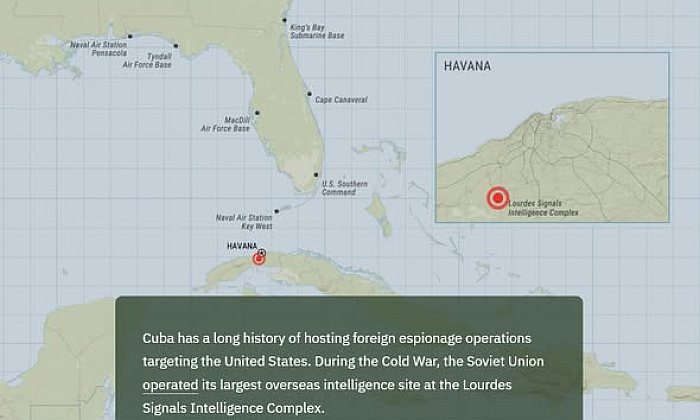
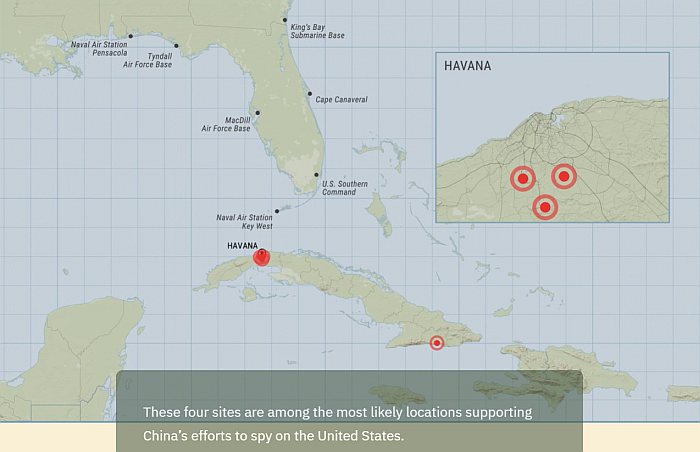
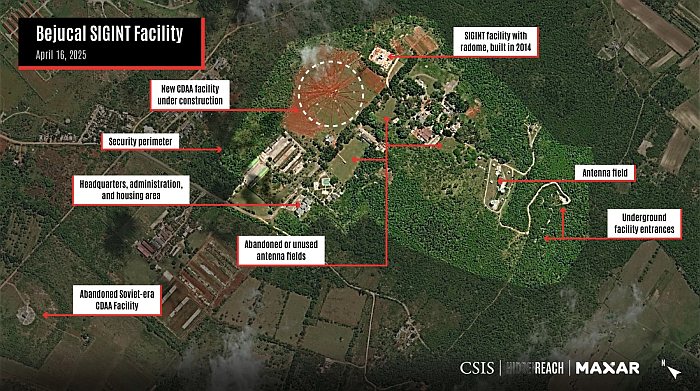
CSIS updated the information in December 2024 and then on May 6, 2025, which prompted hearings in the House Homeland Security Committee, urging action.
The military cooperation between China and Cuba is no secret.
Recently, in September 2025, China’s Defense Minister, Admiral Dong Jun, received his Cuban counterpart, Alvaro Lopez Miera, in Beijing. They discussed practical aspects of the agreements reached by Emperor Xi and Cuban leader Diaz-Canel during celebrations for the end of World War II.
China supports Cuba’s struggling economy, has established several factories there, and provides loans. In exchange for some military presence.
Interestingly, after visiting Moscow in November 2022, Díaz-Canel visited Beijing, where 12 agreements were signed, including mechanisms for providing Cuba with emergency assistance with money, medicines, food, and other materials. The official trade turnover between China and Cuba is significantly larger than between Cuba and Russia.
5. The nuance is that the scale of Chinese military presence in Cuba is unclear
The media features quite active opposition writers who claim the threat is exaggerated. It all resembles “Saddam’s chemical weapons” to some extent.
Soon after the publication of the mentioned CSIS report, critics wrote that attributing to China the infrastructure reconstructed by analysts based on satellite images is an insult to Beijing. Some facilities clearly look like relics of the “Cold War.” China has far more advanced tools. Researchers in Cuba also reported that mostly these are semi-ruins used by Cuba’s army.
Additional confusion comes from the “Havana syndrome” case, where two dozen American and Canadian diplomats in Havana experienced a range of neurological symptoms, including dizziness, nausea, headaches, and hearing problems. Later, hundreds of American personnel in various countries experienced similar symptoms.
Symptoms were first recorded in November 2016 (after Trump’s election) and ended in 2021 (at the end of his term). Under the first Trump administration, incidents were investigated, suspecting microwave weapon impacts from Russia or China. Meanwhile, it was only proven that crickets were buzzing; everything else remains unclear.
Given Trump’s pressure to find an unfriendly trace in the “Havana syndrome,” opponents discredit current suspicions towards China as unproven.
6. The spy situation in Cuba is as follows
The Chinese say – we’re not there.
The Kremlin says – we’re not there, but winks significantly.
Russian formally anti-Kremlin media says – Russians are there.
Republicans in the USA say – Chinese are there, something needs to be done. Rubio is the frontman of this movement.
Democrats – are wavering.
In this context, Trump’s order comes out, listing China after Russia and before Iran, Hamas, and Hezbollah.
If a specific malicious object is indicated for Russia, it states for China: “Cuba continues to develop deep cooperation in intelligence and defense with China.”
The Russian spy menace is more clearly perceived, although it clashes with what Rubio has been saying for at least 10 years. According to the order, Rubio is given serious powers to implement repressive measures.
It is probably a conscious or subconscious desire to win the “1962 Cuban Missile Crisis.” The Chinese appear in that context remarkably. Because they weren’t part of that story.
Now they are the main target, regardless of the real scale of their presence in Cuba.
Hypothetically, it could be “proven” that spy radio technicians somehow seriously harmed something. For example, sunk Musk’s rocket. This could serve as a reason for targeted attacks. Since the Chinese are “not there,” and the Russians will remain quiet – the claims will be tolerable. And the effect appealing.
Let’s observe how radio engineering rhetoric will be presented on the US-Cuba track in the coming months.
