
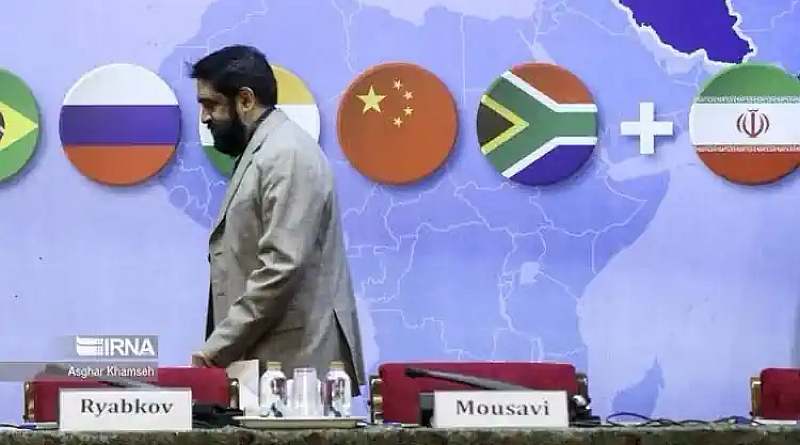

The expansion of global turbulence leads to the restructuring of international geopolitical space. While there is a lot of discussion about the problematic aspects of weakening Euro-Atlantic relations and disagreements within the EU, there isn’t as much on the crisis of “alternative groups.”
Perhaps the non-Western intergovernmental architecture was weak and formal in itself, but now due to the collapse of the Maduro regime in Venezuela, the difficult, if not critical, situation of the Iranian leadership, and the decline of Moscow’s international authority due to the inglorious four-year invasion of Ukraine, a dysfunctionality and disintegration of several groups on which Russia relied is observed.
The future of the BRICS ten is in question; the geopolitical community is literally bursting at the seams and resembles a terrifying chimera. What is the purpose of this formation if its participants do not show mutual support, as in the case of China and Russia’s refusal to support Iran amid US and Israeli military operations? Moreover, the Russian side is interested in escalating the situation around Iran to maximize profits from a spike in oil prices due to disruptions in energy supplies from the Persian Gulf.
While Iran is engaged in an existential struggle for survival, its Russian pseudo-partner is seeking opportunities to negotiate with Trump in hopes of securing relaxations for selling Russian oil on the global market. However, Russian losses should be noted: due to the Iranian war, the concept of the “North-South” corridor is crumbling, turning Russian dependence on China into a verdict. Beijing takes control of Russia as its reserved sphere of influence, dictating economic and pricing conditions incompatible with sovereign existence.
A painful blow to BRICS came with the armed conflict between two of its members, namely Iran and the UAE. Can states in a state of war cooperate? On March 1, 2026, the countries severed diplomatic relations, and the period of constructive coexistence ended in an armed conflict with unpredictable consequences.
Amidst the described cracks in BRICS, the Trump administration is pushing the authorities of South Africa to leave BRICS and return to a course of non-alignment. For South Africa, participation in BRICS incurs increasing costs, and it is not excluded that Africa’s largest economy might indeed leave the bloc. Situationally, Pretoria benefits from the war against Iran, as a significant portion of cargo from Europe to Asia is once again bypassing the Cape of Good Hope.
The fact that the war in the Middle East reduces Russia’s influence speaks not only to the crisis in BRICS but also to the further disintegration of the CIS. Following Georgia and Ukraine, the founding country of Moldova is leaving the surrogate USSR ranks. The government in Chisinau approved a bill to denounce the basic CIS agreements — the founding agreement, its annex, and the organization’s charter.
Moldovan Foreign Ministry laments: the fundamental principles of the CIS are no longer being observed — primarily the provision on mutual recognition of territorial integrity and the inviolability of borders! According to the Ministry, this principle was violated by Russia, which conducts an aggressive and destructive war against Ukraine. Before this, in 2008, Russia committed aggression against Georgia and continues to illegally maintain troops on Moldovan territory. Moldova’s exit from the CIS signifies its desire to remove Moscow’s decorations and demand the withdrawal of Russian troops from Transnistria.
In fact, the CIS was merely a cover for Russian interventions, and the question arises: why should an aggressor and the victim remain within the same institution, which by its status does not resolve interstate problems and crises but only covers blatant violations of international law.
