
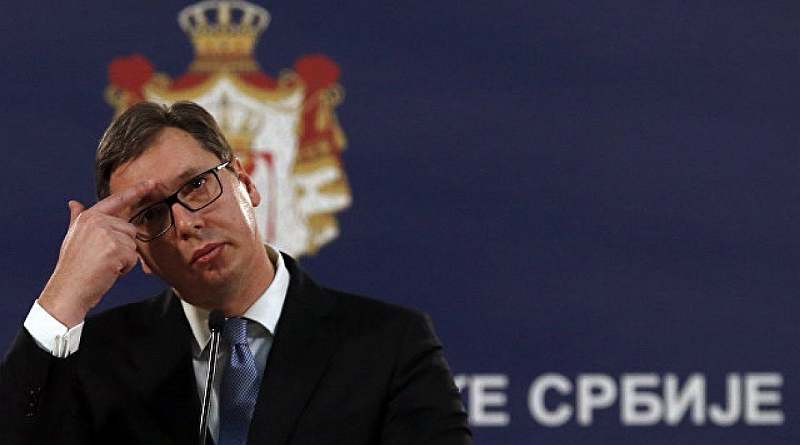

The latest statements by Serbian President Aleksandar Vučić, claiming that Croatia, Albania, and Kosovo are forming a military alliance to attack his country, appear as a classic example of political paranoia. However, behind this rhetoric lies not so much fear of neighbors as a cold calculation and the notorious “long hand” of Moscow.
This refers to the “Triple Declaration” signed in March 2025, which is actually a regular military cooperation agreement within NATO standards. So why now, in March 2026, does this document become a “plan of aggression” for Belgrade?
Analysis of Serbian opposition resources such as Danas and Nova.rs, as well as reports from European intelligence services, points to a clear “Russian trace.” Moscow’s influence on Serbian intelligence services through figures like Aleksandar Vulin, who regularly visits Moscow for consultations with the SVR and FSB, allows the Kremlin to “feed” Belgrade with the necessary intelligence data.
Through information injections, Putin’s intelligence services aim to maintain the feeling of a “besieged fortress” in Serbia. This blocks attempts to move closer to the West and makes Serbia dependent on Russian air defense systems and intelligence.
For Putin, the Balkans play the role of Europe’s “soft underbelly.” If things do not go as planned in Ukraine, creating a zone of tension in the Balkans is the ideal way to distract the attention of the EU and NATO. Vučić, in this game, acts as a transmitter of Kremlin fears.
Notably, Vučić’s statement about an anti-Serbian conspiracy coincided with two key international factors.
The first is the Iranian crisis. The direct confrontation between Iran and Israel, which Vučić mentions in his interviews, comparing the situation to the 1999 Yugoslav bombings, is used to create an atmosphere of the “end of the world.” This is a classic technique: scare the population with a global catastrophe so they rally around a “strong leader.”
The second factor, as usual, is the long war in Ukraine. By 2026, with Russia’s resources depleted and Europe preparing for a long-term confrontation, a “second front,” even if just informational, is critically important to Moscow. Additionally, by announcing the purchase of CM-400 Chinese hypersonic missiles, Vučić effectively confirms Serbia’s role as an anti-Western stronghold.
Local reasons should not be forgotten either. On March 29, local elections will be held in several key municipalities in Serbia. The ratings of the ruling Serbian Progressive Party have been undermined by environmental protests against lithium mining and economic pressure. Military hysteria becomes the best way to silence the opposition. As Serbian politician Radomir Lazović aptly noted: “This is Vučić’s proven method – creating enemies out of neighbors to present himself as the only savior.”
Thus, the “threat of an attack” on Serbia exists only in Vučić’s imagination and in analytical reports sent from Moscow. What we see is synchronized work:
Moscow supplies fear and “secret data” about NATO conspiracies. Vučić converts this fear into domestic ratings and justification for military spending. In the end, Belgrade remains a hostage to a policy that, instead of European integration, leads the country into isolation under the guise of “Chinese missiles” and “Russian friendship.”
The real danger for Serbia is not the virtual “Albanian-Croatian alliance,” but its status as a puppet in the hands of the Kremlin, ready to burn the Balkans to delay its downfall in Ukraine.
