
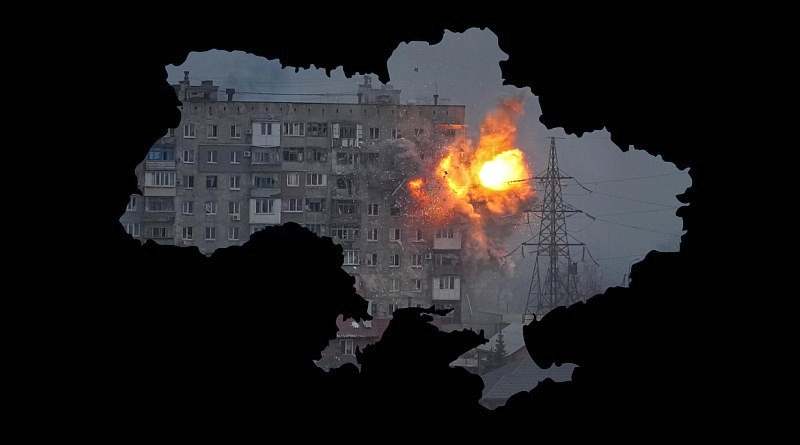

History is a stern teacher. It repeats lessons until they are learned. It seems the world has not learned the lessons of the 20th century. We again see what seemed long buried under the rubble of wars and totalitarian regimes. For many years, war and war crimes were confidently declared “never again.” But once again has come again.
That is why it is so important to correctly name and understand what is happening today.
February 19, 2014— a date that should sound much louder. On this day, twelve years ago, the War for Ukraine’s Independence began. This date is recorded in Ukrainian law. But in public communications — even at the highest level — it is almost unheard of.
Instead, on February 24, we hear everywhere about the “beginning of the war” four years ago. They count the days of the full-scale invasion. However, this is not just an inaccuracy in chronology. It is a faulty perspective. And a faulty perspective in war can be very costly.
Understanding war is a resource. It determines where we are, where we are going, and what victory might be.
Napoleon claimed that three things are needed for victory: money, money, and more money. Despite all his genius, he lost his main war and ended his life in exile. So, money is not enough. There are other resources. One key resource is meaning.
Today, meaning is the object of a systematic attack.
In Ukraine, the formula “it must all be stopped” is increasingly heard. Sometimes even the word “war” is avoided. But how exactly to “stop it” is not explained. Yet, the imperative “to stop” gradually replaces the question “what are we fighting for?” And this is already an undermining.
We see an attack on meaning from Russia. We are told that the war could have been avoided if Ukraine had conceded Crimea, Donbas, or other territories. This is manipulation. Because Russia’s goal is not territories per se. Its goal is the destruction of Ukraine as an independent state.
We also see another attack — from some Western politicians who call this war “senseless” or one where “it’s unclear what people are dying for.” When a war is stripped of meaning, it is easier to propose “ending” it at the expense of the defender.
Therefore, for us, it is crucial not to lose perspective.
We successfully secured in the legislation the correct term — the War for Ukraine’s Independence. It is not just a formula. It is a meaningful construct.
It explains what we are fighting for — independence.
And it explains what the enemy is fighting for — to ensure that this independence does not exist.
Without this understanding, it is easy to get lost in negotiations or their imitation. To start believing that if one more territory is surrendered, the war will stop. But history — both ancient and recent — shows that concessions in an aggressive war do not satisfy an empire. They only confirm its rightness in its own eyes.
The definition “War for Ukraine’s Independence” writes our struggle into the broader context of anti-colonial processes. And this is crucial for communication with the world — especially with countries in the global South. There, the language of anti-colonialism is well understood, but Ukraine is often misunderstood. There, Ukraine is sometimes presented as a “proxy of the West,” and Russia as a force opposing “old empires.” This is a false picture. And it is partly a result of our own communication gaps.
We must clearly explain that the existence of Ukraine as an independent state is not only a matter for Ukrainians. It is a matter of world order.
The fall of Ukraine would mean the destruction of the principles on which the world was built after the last world war: the inviolability of borders, the right of peoples to their own state, the priority of international law over the law of force.
Ukraine became independent not by chance. It realized itself as a state in a world that had agreed on rules: on the inviolability of borders, on the right of national states to exist, on human rights.
Therefore, when we talk about the War for Ukraine’s Independence, we must understand: it is not just about defending territory. It is about defending the principle of independence itself.
And from this understanding, our position must emerge — both within the country and externally. In public speeches and at international negotiations.
Because without independence, everything else — compromises, formulas, guarantees — loses meaning.
