
The full-scale war of Russia against Ukraine has become the biggest security challenge for Europe since the Cold War and a powerful catalyst for NATO’s transformation. The Alliance is rethinking high-intensity warfare, accelerating the implementation of innovations, adapting its structure and doctrines, considering the role of new technologies: from drones to artificial intelligence.
Thanks to successfully resisting the aggressor, Ukraine has gained unique combat experience, which is already influencing the decisions of allies. A special role is played by NATO’s Command for Transformation and the NATO-Ukraine Joint Analysis, Training and Education Center (JATEC), which integrates Ukrainian experience into the Alliance’s training, doctrines, and innovations.
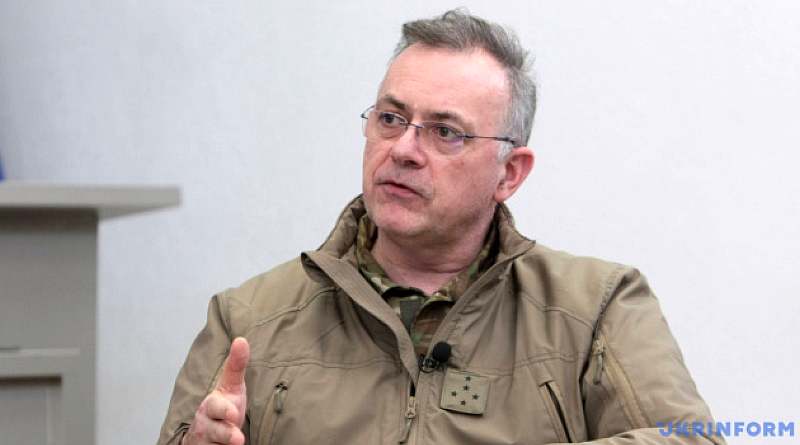
In an interview with Ukrinform, Admiral Pierre Vandier, the Commander of the NATO Joint Armed Forces for Transformation, spoke about how the war is changing the Alliance, what lessons NATO has learned, how the transformation strengthens support for Ukraine, and what role our state will play in Europe’s future security.
ADAPTABILITY – ONE OF UKRAINE’S MOST IMPORTANT LESSONS
– Admiral, you lead the transformation direction in NATO. How has Russia’s full-scale war against Ukraine changed the strategic vision of the Alliance’s transformation? What does the military operation in the Middle East add to this vision?
– The invasion of Ukraine was a shock for many Europeans who believed that such a war was impossible in Europe. And therefore, it was a shock of realism.
The scale of the invasion and the expenditure of ammunition, which exceeds our production capabilities, caused a shock, leading to a realization by leadership across Europe of the need to transition to a new era. They need to produce more. They must have greater ammunition stocks.
Therefore, the primary task was to help Ukraine fight today. And over the past years, this has been the basis of our efforts. But today, four years into the struggle, the question arises: how will we fight tomorrow?
We see that the enemy adapts very quickly. And now
all our efforts are directed at encouraging countries to develop advanced technologies in the coming years.
You know that in The Hague, member countries committed to allocating 3.5 percent of their GDP to defense. Which means we need to invest in the future, not the past.
As for the Middle East, we see the level of violence. And we see the actual challenges (regarding protection from Iranian drones, – ed.) Ukraine is undergoing.
Every day we observe strikes on infrastructure targets: whether they are data centers, oil refineries, or critical facilities. Hence, we see that what happened in Ukraine is actually a new way of conducting warfare today. And this gives a powerful impetus to the spread of trials conducted by Ukraine among all allies.
– In four years of full-scale war, the Armed Forces of Ukraine have become one of the most experienced armies in the world. They quickly adapt on the battlefield – from the use of drones to the implementation of new targeting tactics. Does NATO integrate any specific elements of Ukrainian combat experience into military training, operational planning, and military structure?
– The first consequence of the war in Ukraine was the rethinking of training approaches. We inherited, I would say, very traditional training methods.
And we saw that, given the speed of changes on the battlefield, we need not only to train soldiers to complete tasks but also to teach them to adapt. Therefore, last year we launched a new program for all NATO members called “Audacious Training,” where, essentially, part of the training takes place without a predefined scenario. It uses a “red team” and its improvised actions. This opponent creates tension for the “blue team” and forces it to replan its actions and adapt.
Because we in NATO believe that the “DNA of adaptation” (ability to adapt, – ed.) is one of the most important lessons learned from Ukraine – constant adaptation to combat conditions.
THE WEST HAS UNDERAPPRECIATED THE SCALE AND VOLUME OF BALLISTIC MISSILE PRODUCTION
– It is often said that this war has become a laboratory for modern high-intensity warfare. What technologies or approaches – such as unmanned systems, artificial intelligence, or network-centric operations – most change the modern battlefield?
– We have three areas in which we observe extraordinary progress.
The first is space, specifically the use of commercial space. When it comes to communication, we see the role of Starlink, for example. But we also see commercial satellite imagery and commercial electronic warfare.
The second area is robotics. Whether on land, at sea, underwater, or in the air, we see that this area is extremely important and rapidly adapting.
And the third area is information technology and its use for better management and control.
The system (situational awareness, –ed.) “Delta,” invented by Ukraine, is a very good example of how one can quickly adapt and provide the soldier with the necessary information for combat.
So, these three areas are extremely important, and we have special programs to take this experience into account.
– Given the increase in global demand and noticeable shortage of missiles for air defense systems due to several simultaneous conflicts in the world, does NATO have a strategy for ramping up their production and replenishing stocks in member countries?
– We are working to find an optimal balance of weapon usage to ensure it is effective against specific targets.
In the context of large-scale combat operations, effective weaponry is needed that can be scaled to combat drones launched by the hundreds of thousands. We need to find efficient means that are very cheap to destroy these low-tech threats and then be able to preserve excellent, expensive, and highly precise weapons for the most complex threats, such as ballistic missiles.
Therefore, at NATO, we are working on finding these optimal solutions and on creating a management and control system that will allocate effective means of impact to appropriate targets.
– What about the most expensive ones, such as Patriot anti-missiles?
– I believe that the West did not take into account the scale and production volume of ballistic missiles. We had warnings, for example, regarding the Houthis in Yemen, and that such a small country is capable of striking maritime shipping with the help of ballistic missiles.
This should have alerted us. We should have said: well, we need to act differently.
At that time, the production line of complex missiles was not as powerful. And now, I think we are in a situation where we need to act quickly. We need to ramp up such production. These are sophisticated weapons, so manufacturing will take some time.
– One of the tools of cooperation between NATO and Ukraine is the Joint Training and Education Center (JATEC) in Bydgoszcz. In view of JATEC’s work on experience and information exchange, when can we expect the creation of a completely compatible command and communication system for sharing military data between NATO and Ukraine, particularly for transmitting confidential information?
– I would say this is a complex topic because, to establish such a level of exchange, we need to reach agreements between the 32 member countries and Ukraine. But today, we have done a good job.
For example, we had a rather successful innovation contest regarding gliding bombs. We are working on countering fiber-optic drones, which is another challenge. And we have involved Ukrainians in the “red team” of our exercises.
Thus, part of the success of the “Audacious Training” program today is Ukraine’s success.
COGNITIVE WARFARE PLAYS AN IMPORTANT ROLE IN COUNTERING HYBRID THREATS
– Russia actively uses hybrid tools – cyberattacks, information operations, sabotage, and pressure on critical infrastructure. How does the Alliance’s transformation take into account these emerging types of threats?
– A good example is the operation “Baltic Sentry” (“Baltic Sentry“, – editor’s note). When a year ago cables were cut in the Baltic Sea, the Supreme Allied Commander Europe started this operation, where we combined all coastal resources on islands, ships, maritime patrol aircraft. And we, the Allied Command Transformation, created a fleet of unmanned surface vehicles to monitor the Baltic Sea.
Here is an example of how the Alliance responds in the maritime area at the level of certain islands. This means that all 32 countries cooperate in addressing this issue.
In a broader sense, I believe that this operation in the gray zone serves as a kind of pressure.
And indeed, this is where cognitive warfare plays an important role.
Part of this war is enhancing the resilience of our countries.
The ability to adapt, ensure deep protection, and have a population that is not passive in the fight. This is what we had during the Cold War. We need to regain this experience.
– The war in Ukraine has also shown the importance of mass production of cheap technologies, including drones and electronic warfare means. Does this change NATO’s approach to balancing expensive high-tech military systems with mass low-cost solutions?
– Yes. The Alliance is doing extensive work on these two tracks. There’s a slow and complex path where you seek advanced, best technologies to have an advantage. And there’s another path where you need to move very quickly with mass systems.
Drones are a good example. This year, I was told that Ukraine will produce almost 10 million drones. The West must have the same scale.
The problem for the West and Europeans is that they are not at war. And given the rapid obsolescence of drones, stockpiling them doesn’t make sense. So, we need to find a way, and that way lies in training staff to ensure that the industry and technologies are always at the forefront of progress, with the ability to scale up production.
Thus, this is how we need to respond to the demands of countries to ensure that if we enter a war, we can rapidly increase capacity and have the latest technologies.
WE NEED RIGOROUS TRAINING FOR STRESS TESTING OUR SYSTEM
– Recently, Ukrainian military for the first time led the opposing forces during the REPMUS / Dynamic Messenger exercises, where unmanned Magura V7 vessels were used in the practical part with positive results. How does this experience of adapting new technologies at sea affect NATO’s maritime transformation?
– Those boats were rented by my command. I paid for it because that’s what I wanted.
This is what I was telling you about the “red team.” It’s about creating more complex and realistic conditions for training. As a result, we can achieve greater effectiveness of the “blue side,” develop advanced technologies, and be prepared for such a war.
This is a great success for the Ukrainian side – sharing this experience with us and making us stronger. This is the level of training we strive for, where we don’t conduct exercises on paper with blue skies and incubator conditions. We need rigorous training to stress-test our system.
– Any details about these exercises?
– These were exercises, so certain limitations remain. But in my opinion, it is positive that we were able to better understand at which stage of development this technology is and what achievements of Ukraine are a threat to the adversary, what we need to work on.
THE IMPLEMENTATION OF STRATEGIC AND OPERATIONAL TRAINING IN UKRAINE ACCORDING TO NATO STANDARDS IS BECOMING RELEVANT
– Let’s return to the activities of JATEC. Just over a year ago, you opened it. What are the specific results of JATEC’s activities?
– First, the strengthening of the “red team.” This is done in NATO’s interest to incorporate this combat experience into the Alliance’s activities.
As for Ukraine, we held two competitions: regarding glider bombs and fiber optic drones – and they were very successful.
Furthermore, we have another program that Ukraine requested. We will work on training, specifically on how to implement strategic and operational training in Ukraine according to NATO standards. This is mutually beneficial cooperation.
SUPPORT FOR UKRAINE HAS HELPED CREATE AN UNDERSTANDING OF REAL WAR
– We have already talked about hybrid tools and hybrid threats. Are new mechanisms for collective response to hybrid threats, which might not fall under the traditional interpretation of Article 5, being discussed within the Alliance?
– Indeed, we deal with this daily. Specifically, these are vigilance enhancement operations.
So, you have a dangerous situation that triggered a vigilance enhancement operation: one in the Baltic region, others on the eastern flank after drone intrusions into Poland. Another is now launched in the Arctic.
This is a way to assess the problem and form forces that will address the issue in different areas and spheres, using space, real platforms, and information operations.
– As part of the collective response, is only the deployment of quick reaction forces carried out in such areas? Or do you have a different vision for response?
– I cannot publicly discuss the scope of what is being done. This is global planning covering many areas, and the main strength of the Alliance lies mainly in integrating all countries. Thus, it’s about standards and the ability to work together very cohesively.
Secondly, it’s the capability to unify all domains. Even those domains managed by individual countries will be integrated into the overall picture. This gives our position significant strength.
– Can it be said that the war in Ukraine has effectively accelerated NATO’s transformation by decades? What role will Ukraine play in this process in the future?
– Undoubtedly, after the war in Ukraine, a new era has begun for NATO. Because we have commitments for resources from 32 countries amounting to 3.5 percent of GDP, which is approximately double today’s level. Across Europe, by 2032, we must achieve defense spending of $800 billion per year.
Both what Ukraine is experiencing during the war and what we have seen in the Middle East, as you asked earlier, indicate that we are making significant efforts not only in repeating old approaches but also in thinking about the next war and new methods of warfare. These methods will enable us to win, rather than compel us to fight a losing war. Therefore, we are making intellectual efforts, efforts in training, as well as technological efforts to ensure that we maintain an advantage in the future.
– What about Ukraine’s role in your transformation plan?
– I believe supporting Ukraine has helped us understand what real war is. Ukraine brings this “DNA of adaptation,” constant struggle, and rediscovery. I think NATO can ensure the development of a resilient, reliable, and effective army in the future.
Photo: Hennadii Minchenko/Ukrinform
