
The Russian command enters the winter-spring campaign of 2026 with old ailments: managerial chaos, a mix of units, and a lack of logic in the distribution of forces.
In the first part, we’ll break down the structure of the occupying forces, their real tasks in the north and east, analyze the operational situation in the Sumy, Kharkiv, and Kupiansk directions, and explain why these front segments have become “donors” for the enemy’s main strike.
To begin, let’s draw a general picture of how the enemy’s troops are organized. Russia has five military districts:
Leningrad MD — Group of Forces “North”. Mission — to create a so-called buffer zone in the north of Sumy and Kharkiv regions of Ukraine (our Northern Slobozhansky and Southern Slobozhansky operational directions). Basis — 14th, 44th corps, part of the 6th army, 106th Airborne Division. Total strength — up to 65,000 military personnel;
Moscow MD — Group of Forces “West”. Mission — occupation of Kharkiv region, remnants of Luhansk, and the northern part of Donetsk regions (our Kupiansk, Lyman, Siversky directions). Basis — 1st Tank, 3rd (Southern MD), 6th (Leningrad MD), 20th, 25th combined-arms armies, 11th corps (Leningrad MD). Total strength — up to 90,000 military personnel;
Central MD — Group of Forces “Center”. Mission — to capture Pokrovsk and Myrnohrad (our Pokrovsk direction). Basis — 2nd, 41st, 51st armies (Southern MD), 68th corps (Eastern MD), 76th Airborne Division. Total strength — up to 110,000 military personnel;
Eastern MD — Group of Forces “East”. Mission — to capture Huliaipole and the east of Zaporizhzhia region (our Oleksandrivsky and Huliaipil directions). Basis — 5th, 29th, 35th, 36th armies. Total strength — up to 50,000 military personnel;
Southern Military District — Operational Unit “South”. The tasks here are somewhat more complex: part of the unit is advancing towards Kramatorsk, another part towards Kostyantynivka (our Kramatorsk and Kostyantynivka directions). The main forces are the 8th and 51st armies, the 3rd corps (Moscow Military District), marine groups (four brigades, two of which are expanded into divisions, and a regiment). The troops operate in two tactical groups “Bakhmut” and “Dobropillia”. The total strength is up to 100,000 military personnel.
The picture is completed by Operational Unit “Dnepr”, formed from airborne divisions defending in the Kherson region, covering the entrance to Crimea, and advancing in the Zaporizhzhia region (our Orikhiv and Prydniprovs’kyi directions). The main forces are the 18th (including the 22nd and 40th corps), 49th, 58th armies (Southern Military District), formations of the 14th AK (Leningrad Military District), 98th Airborne Division, 7th, 104th Air Assault Divisions. The total strength is up to 30,000 military personnel.

At the beginning of the aggression, the enemy forces were divided according to the directions of invasion, got involved in combat, and have not been able to withdraw since. A similar mix exists among the formations and units. The enemy command would extract troops from less tense sections of the front and redeploy them to more pressured areas, where they remained stuck for years.
Today, for instance, the 34th brigade of the 49th army is fighting in the Sumy region, while the army itself is in Zaporizhzhia, the 70th division of the 18th army is advancing near Kostyantynivka, while the army defends in the occupied Kherson region. The same situation prevails in the airborne troops, where regiments are detached from divisions and operate hundreds of kilometers away from their formations.
A few words should be said about the intensity of the fighting. Speaking of the daily number of combat clashes, from January 1 to 16, there were 2808, averaging 175 per day. The most — on the Pokrovsk (40 battles daily), Hulyaypole (33), Kostiantynivka (17), Lyman and Oleksandrivsk (14 each), the least — North Slobozhanske (1), Dnipro (1–2), Orikhiv (3), Sloviansk (4).
If we look at the combat clashes through the prism of enemy losses, we see that these are essentially battles of infantry groups unsupported by combat equipment. Since the beginning of the year, the Defense Forces of Ukraine have hit 78 tanks and 65 BBM, which is five tanks and four BBM per day and 0.03 tanks and 0.02 BBM in one combat clash.
The main burden of destroying the enemy is on the drone operators, and almost all combat work takes place within the kill zone. This is something to consider for those building the Defense Forces.
The most successful tactic of the enemy remains the infiltration of small groups through gaps in our defenses, accumulation in the battle lines of Ukrainian units, and activation at the right moment. The main targets of infiltrators are UAV positions and mortar batteries, precisely those elements of the Defense Forces’ battle orders that cause the most trouble to the enemy. Those organizing the BZVP for drone operators and mortar crews should remember: these guys need to be aces in close combat; training programs should be adjusted accordingly.
If we disregard enemy propaganda and official rhetoric, the general picture on the front line can be described as follows (directions, if looking from Kyiv):
North Slobozhanske: everyone, except the headquarters of the enemy’s UV “Sever,” already realized that nothing will work here. The enemy created and maintains four bridgeheads in Sumy region. The largest is formed in the bend of the state border and is limited by the Kostiantynivka — Oleksiivka — Yablunivka — Yunakivka line. Two more are quite small, near Sadki and Oleksandriya. The newest is near Hrabovske, formed by a company of the enemy’s 34th brigade. Attempts to expand the bridgehead towards Riasne ended in losses for the enemy.
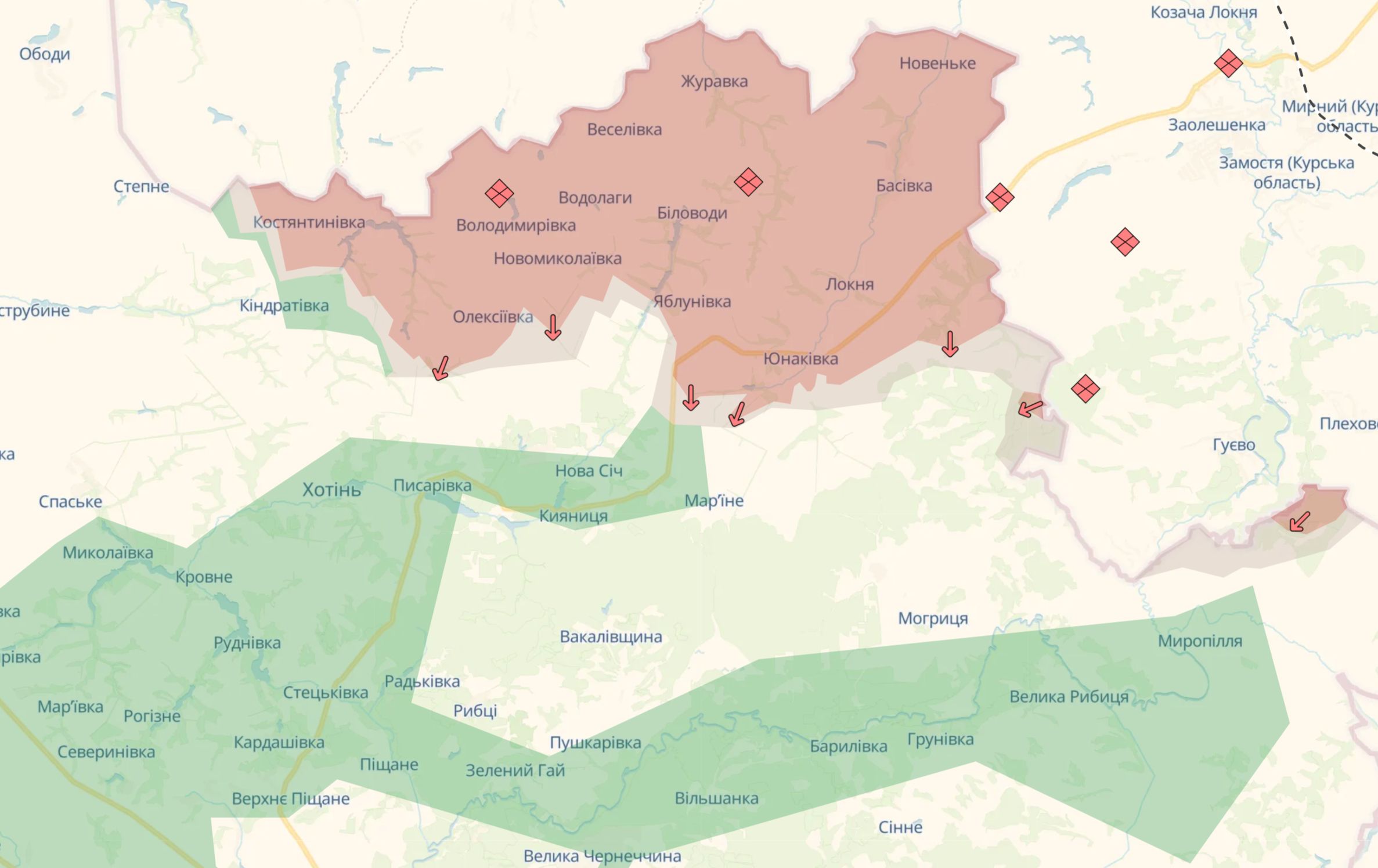
To understand the context of the events in Sumy region, let’s remember that a consolidated rifle regiment is conducting military operations here, formed thanks to parts and units of the enemy’s Airborne Forces, that is, from second-rate reserves for a secondary direction. The entire point of the events here is to regularly show the world that Russia possesses strategic initiative, imposes its will on the Defense Forces, and the Ukrainian defense is fragile and the front is about to collapse. But why the “holder of the initiative” cannot connect its bridgeheads into a buffer zone for more than a year is unknown, most likely because one bridgehead has an area of 0.67 km², and the other is 3.11 km²;
Southern Slobozhansky: In the Kharkiv region, the situation is somewhat more interesting. The enemy has two wedge-shaped areas on Ukrainian territory in the areas of Strilecha — Hlyboke — Lukyantsi — Sontsivka and Starytsya — Vovchansk — Tyke. We do not mention a small piece of occupied territory in the area of Zelenyi with an area of 0.45 km². The northeastern corner of the Kharkiv region is the junction of the operational zones of UV “Sever” and UV “Zapad”. The traditional management chaos creates problems of interaction at the operational and tactical levels. UV “Sever” will try to break through to the Pecheneg Reservoir, to Staryi Saltiv, but cannot capture Vovchansk, a city with an area of 70 km², where 18,000 people lived before the war.
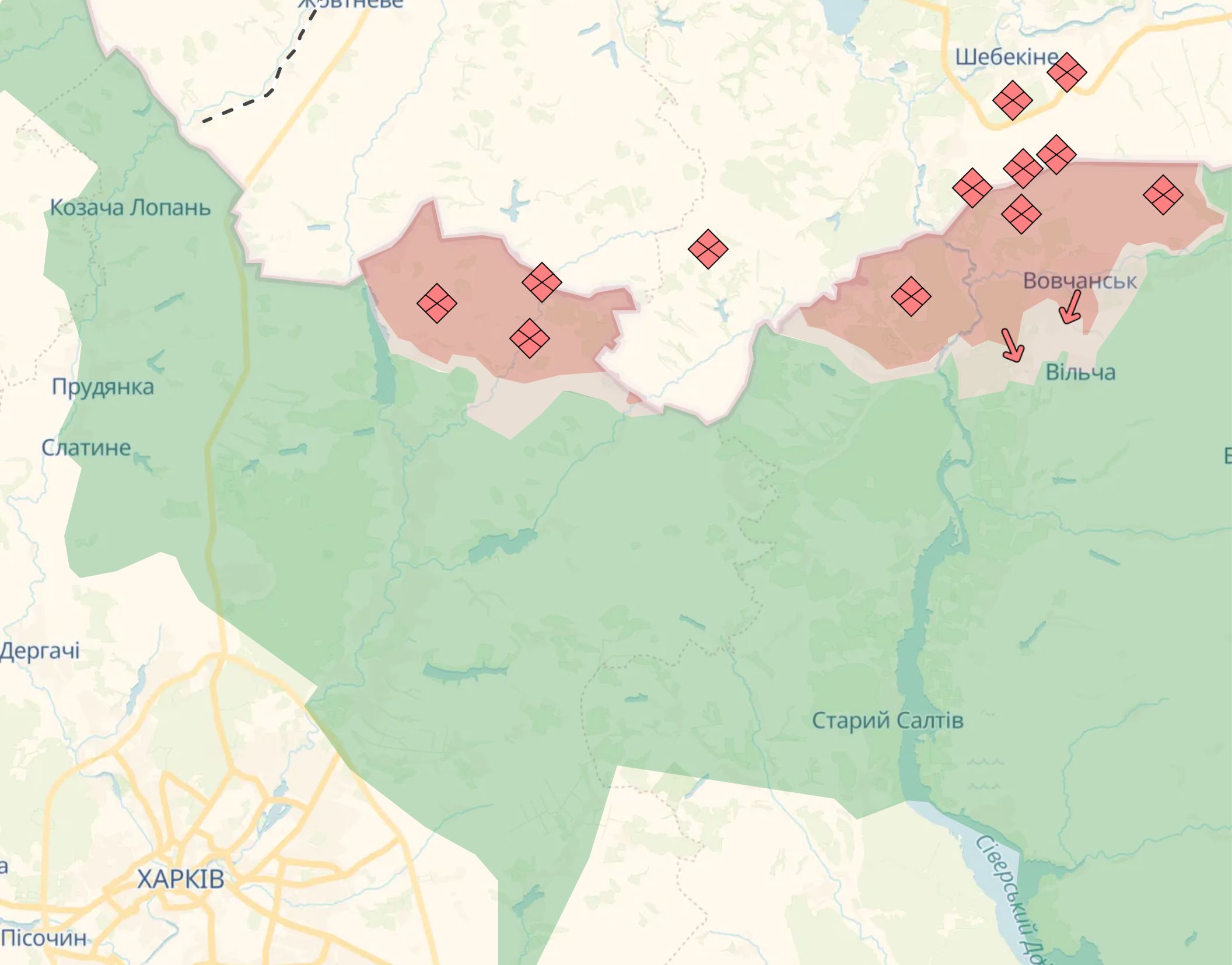
The highlight here is the presence of the 69th Division of the 6th Army. Generally, the 6th Army was advancing on Kupiansk, but one of its divisions (the 69th) ended up in Vovchansk. The straight-line distance between the cities is 80 km, which is quite a lot for an army consisting of two divisions. Near Kupiansk, the 68th Division of the army is trying to save the remaining assault units of the 121st Regiment, which the Defense Forces are finishing off in the basements of the eastern part of the city, hindering the withdrawal of the division that is tangled up under the feet of the 1st Tank Army, not enhancing troop manageability.
The map shows that the enemy has seemingly deployed its group in such a way that the possible directions of its actions are an advance from the border bridgehead around Dvorichanske to Velykyi Burluk, towards the 69th Division, which is sluggishly trying to crawl to Staryi Saltiv. From the bridgehead in the Dvorichne area (and the enemy has not solved the problem of transferring heavy combat equipment there across the Oskil for a year now), it is possible to deeply bypass Kupiansk, but advancing somewhere towards Pechenihy is a doubtful concept.
With high probability, one can assume that sooner or later the 6th Army will pull its 68th Division out of Kupiansk and will tackle the task of occupying the northeastern part of the Kharkiv region, advancing from Vovchansk and Dvorichanske to Velykyi Burluk. All this can happen only after clarifying the demarcation line between OV “North” and OV “West” and transferring the 6th Army to regular “North”.
We keep an eye on the 11th Corps (which has an entire division, the 18th). There is also the 14th Corps of the Leningrad Military District, but one of its brigades, the 200th, is self-destructing under Chasiv Yar, and the other, the 80th, Arctic in structure, is fighting in Kherson, which is hardly an Arctic. Finland’s accession to NATO and Norway’s long-standing presence in the organization have already prompted the Russians to deploy the 44th Corps in Petrozavodsk. To counteract, so to speak. Clearly, it’s time to form another division on the Kola Peninsula. And strategic aviation at the base in Olenivka will feel more secure, in case of a new “Web”?
Kupiansk: Above we understood that there is no agreement between Operational Group “North” and Operational Group “West,” which works to our advantage, and how they will build this agreement is not our problem. The informational-military lynchpin of the Kupiansk program, dare I say, a spatio-temporal paradox, is the battle for the city. The Russian General Staff claims that Kupiansk has been “liberated” by the troops of the 1st Tank Army. The commander of Operational Group “West,” General Kuzovlyov, receives the Hero of the Russian Federation for this pseudo-achievement. The President of Ukraine records a video from Kupiansk, Defense Forces units conduct sudden strikes in Radkivka, Holubivka, and Myrne, surround Russian units within the city, gradually dissect the surrounded into several pockets, where they finish off the remnants of enemy assault troops.
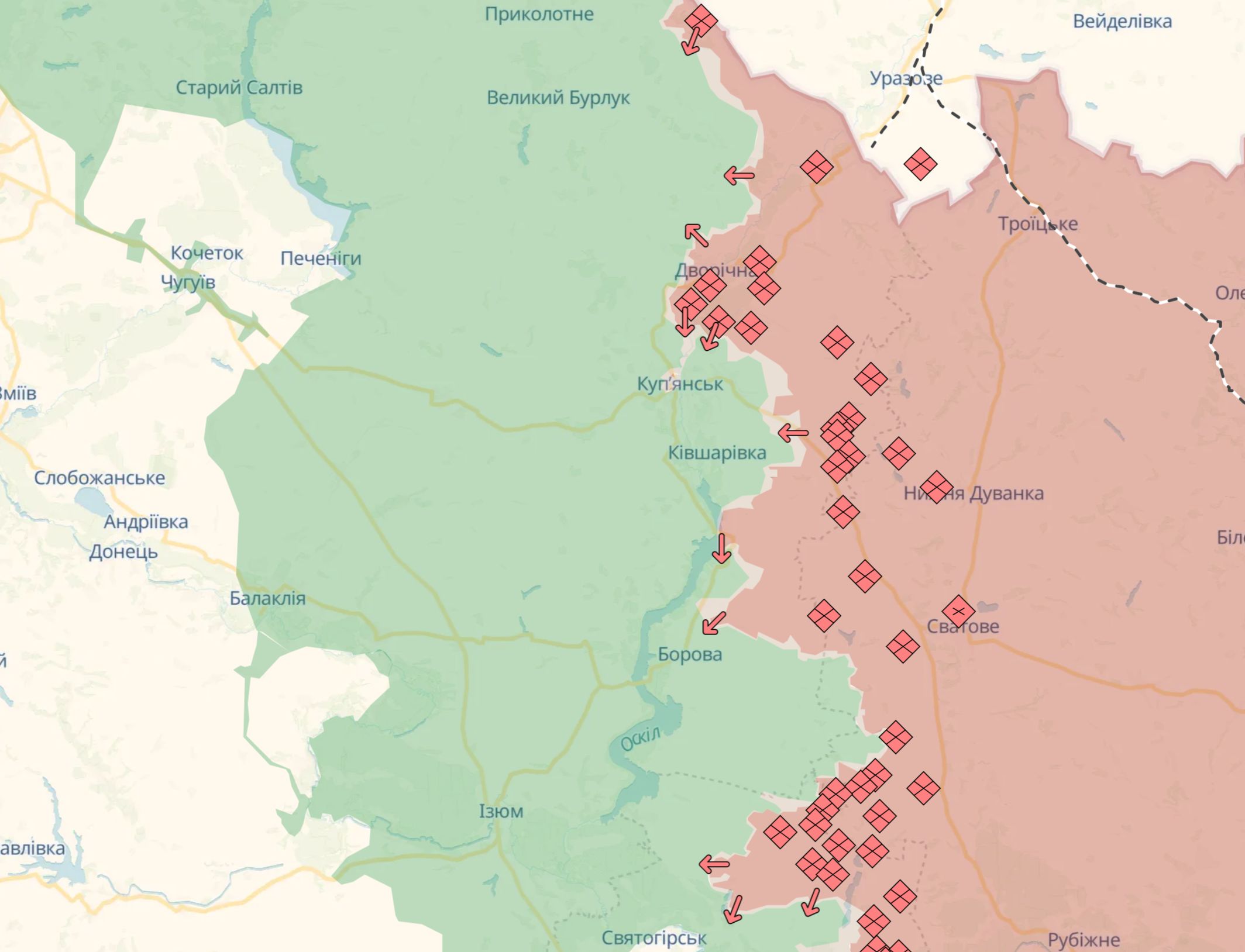
The 1st Tank Army of Operational Group “West” will try to perish in full strength, proving to the world that “Kupiansk is ours!”, while its southern flank (4th Tank Division) will attempt to push the Defense Forces beyond the Oskil Reservoir, trying to secure the northern flank of the group, which will assault Sloviansk.
The picture emerges that Sumy and Kharkiv in the context of the enemy’s winter-spring offensive campaign will remain secondary directions, the groups “North” and “West” will focus on generating forces, becoming reserve donors for the main direction.
Continued.
On the cover: the army of occupiers. Photo: occupiers’ media
