
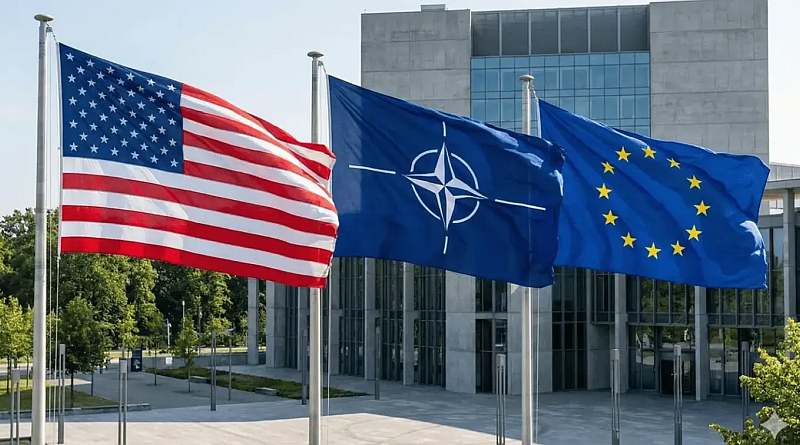
Is this the end of NATO? Have the United States—the strongest and largest member of the alliance—finally sabotaged the longest-lasting institution in modern history? Is Europe now forced to defend itself against Russia and other military threats on its own? These are just some of the questions currently alarming concerned European leaders and military strategists. The prospects and sentiments remain grim.
The reason for the panic that has gripped Western European capitals can be summed up in one word: “Trump.” Since coming to power a year ago, the U.S. president has increasingly scorned Europe and treated his European NATO allies with hostility. He repeats the accusation he made during his first term: that Europeans are not paying their share of NATO expenses and are “freeloading” on the American nuclear umbrella. During his election campaign, he was blunt: Russians can do “whatever they want” with a NATO country that does not pay its bills, he emphasized. But even when most European countries quickly increased their defense budgets, he continued to argue that America is still paying too much.
By refusing to provide military and economic aid to Ukraine, he has struck a blow to NATO solidarity. He made it clear that Ukraine is Europe’s problem, and the U.S. would conduct negotiations with Russia without consulting the Europeans. European leaders frequently visited Washington in an attempt to stop Trump’s deal with President Putin, which would effectively force Ukraine to concede to all of Russia’s demands. At one point, he halted the exchange of intelligence between the U.S. and Kyiv and then insisted that Europeans buy weapons from America if they want to continue military aid to Ukraine.
At the same time, the Trump administration pours scorn on European culture, political parties, and movements it views as anti-American liberalism.
At last year’s Munich Security Conference, Vice President J.D. Vance stated that the greatest threat to Europe comes not from Russia or China but “from within.” He said that European governments are retreating from their values by ignoring voters’ concerns about immigration and suppressing free speech. He mentioned that the basic freedoms of religious people are under threat in the United Kingdom, typically considered America’s closest ally. Over the past year, Trump himself has repeatedly criticized the European Union. He claimed that the economic bloc was created to “spite” the United States. In December, he called Europe “weak” and “decayed” and asserted that it faces “civilizational destruction.”
All this outraged and alarmed European leaders. However, the greatest concern was triggered by Trump’s statement that America should own Greenland—a large, sparsely populated Arctic territory that is part of the Kingdom of Denmark. Trump threatened to use military force to invade and seize Greenland if Denmark did not agree to sell or give it to America. He claimed that the Europeans would not be able to stand up to America. When eight European countries sent a symbolic military contingent to the island to signal support for the Greenlanders, and to recognize the strategic importance of the territory, Trump threatened punitive tariffs for all the countries involved, including the United Kingdom.
Trump’s threat to seize Greenland by force dealt a devastating blow to the fundamental principles of NATO. The key provision of the 1949 treaty is Article 5, which states that an attack on any NATO member will be considered an attack on all, obliging each country to assist the attacked member. No one anticipated an attack by one NATO member on another, although there were minor incidents between Greece and Turkey in the Aegean Sea in the 1990s. But it was unthinkable that all NATO members could unite with Denmark to use military force against the United States—the richest and strongest NATO member at the time.
In January, when Trump attended the conference of world leaders and economists in Davos, Switzerland, there was a tense discussion about Greenland. U.S. allies were particularly angered by Trump’s accusations that the NATO member countries’ troops, assisting Americans in fighting the Taliban in Afghanistan, were barely participating in combat and staying behind the front lines. The British Prime Minister Keir Starmer stated that this was an insult to British troops, who suffered the highest casualties after the Americans. Denmark, which also sent troops, lost more soldiers per capita than any other NATO ally. Trump did not apologize but later stated that allied troops fought bravely. However, the insult remained, and European leaders saw it as further evidence that Trump was not very concerned about the military alliance with European NATO members.
Military strategists are now seriously considering whether Europeans should start planning a defense alliance without America. This would mean the end of NATO. The alliance depends on the U.S. for critical areas such as missile defense systems, surveillance and intelligence, satellite reconnaissance, transport logistics, and key components of weapons sold to Europeans.
British nuclear weapons need to be serviced by American manufacturers and cannot be used without America’s consent. Without American strategic potential, Europe would not be able to conduct operations independently in any future conflict. This prospect became alarmingly real when, on February 12, U.S. Defense Secretary Pete Hegseth informed allies in Brussels that the U.S. was “no longer prioritizing European defense.”
Some European politicians believe that the situation may normalize in three years when Trump is no longer president. However, others consider this unlikely. After significant disruptions to NATO’s operations, it will be very difficult to restore the former level of trust and rebuild security structures. Future American presidents may also view the value of the alliance skeptically as they focus on strategic challenges from China, which is becoming a political and military superpower.
At the Davos summit, Canadian Prime Minister Mark Carney delivered a powerful speech summarizing Europe’s concerns about the disruption to the world order and Western security structures caused by Trump’s policies, which had maintained stability since 1949. “We are in the process of breaking apart,” Carney said. The old world order will not return. He noted that the rules-based system is disappearing, and “the strong can do what they can, while the weak must endure what they must.” He did not mention Trump, but the criticism was obvious. Trump was furious, called Carney ungrateful, and threatened Canada with 100% tariffs if it entered a trade deal with China.
Western leaders fear that the insults exchanged across the Atlantic will not be forgotten. The EU has decided to take a tough stance against Trump’s tariffs while trying to create a more unified European defense alliance without America. However, the damage will be long-lasting, especially for countries like the United Kingdom, which rely on cooperation with the USA in defense and intelligence.
Some high-ranking Republicans in Congress are upset by Trump’s quarrel with Europe and are trying to make the president adhere to the US’s commitments to NATO. But the internal opposition to Trump is weak, and overall sentiment in America is increasingly leaning towards isolationism. It is unlikely that NATO will remain an effective military alliance by the end of Trump’s presidency. Therefore, the alliance will certainly be unable to adequately assist Ukraine in confronting Russian aggression.
Michael Binyon – an Officer of the Order of the British Empire, English journalist. He was the Moscow correspondent for “The Times” newspaper and also reported from Bonn, Washington, and the Middle East. He is a leading writer for “The Times” and occasionally contributes as an art and literature critic.
