

Information on the current losses of the Russian Federation due to sanctions as of 10/16/2026.
1. Russia’s oil and gas revenues will increase by 10% year-on-year in October — up to $12 billion.
– Russia’s federal budget will receive 1 trillion rubles ($11.97 billion) in taxes from oil and gas in October 2026. This is a 10% increase compared to October last year. Compared to September, revenues will more than double due to the quarterly payment of additional income tax from oil extraction. Without this tax, October collections will rise by approximately 164 billion rubles, or 36%.
– Calculations are based on data on oil production, processing, and supply. Higher global prices, driven by the conflict in the Middle East, support Russian revenues; however, this effect is partially offset by an expected production decline of about 5% in Q3 2026 compared to the same period last year.
– Russia’s budget for 2026 anticipates 8.918 trillion rubles in oil and gas revenues from a total revenue of 40.283 trillion rubles. Meanwhile, for January–October, their volume is estimated at 6.45 trillion rubles — 14% less than for the same period last year.
2. Russian business profits are declining, and regions are projected to see a decrease in tax revenues up to 20%.
– Tax revenues to Russia’s regional budgets are declining due to the worsening financial condition of enterprises. Nearly a third of Russian companies are operating at a loss, and the tax increases, which federal authorities are using to compensate for budget losses, are putting increasing pressure on businesses.
– In the first half of 2026, corporate profit tax revenues in Russia increased by 7% to 2.85 trillion rubles. Regional budgets received 6% more than in the same period last year. However, this effect is waning.
– The main impact from the decline in enterprise profits is expected in 2027. As of early September, profit tax revenues were already decreasing in 32 regions of Russia. The most challenging situation is in regions dependent on the coal, metallurgical, and oil refining industries.
– The federal government is attempting to protect the budget through additional taxes, including a tax on the windfall profits of metallurgical companies.
– Regional administrations lack similar tools and may face sharp revenue declines by the end of 2026 and early 2027.
– In the inertia-based scenario, considered the most likely, profit tax revenues nationwide are expected to decrease by 5-10% in 2027. In a more favorable development—if the Bank of Russia lowers the key rate to 10-12% and global oil prices remain high—revenues might increase by 0-5%.
– Meanwhile, in a negative scenario, tax revenues to regional budgets could shrink by 15-20% within the next 10-12 months.
– The positive scenario is considered unlikely: the tax increases, initially meant to quickly close budget gaps, have exhausted their effect and may further weaken businesses and reduce actual tax revenues.
3. Russia has built a new base on the Don for massive launches of jet drones against Ukraine in six weeks.
– Russia has almost completed the construction of a new base for launching jet strike drones in the Rostov region in a month and a half. The facility is located about 3.5 km from the Millerovo airbase, where the 31st Guards Fighter Aviation Regiment is stationed.
– Satellite images from Planet Labs and Airbus show that on August 31, there was an empty field at this location, and by October 14, a complex covering about 0.9 sq km appeared.
– The base is estimated to be intended for launching “Geran-4” and “Geran-5” jet drones. The site includes eight platforms for launchers. Rails for launching drones have been mounted on two platforms, and construction was underway on two others. The facility could be fully operational within a few weeks.
– The new base will expand Russia’s network of stationary sites for launching strike drones, which already includes at least 11 facilities. According to Mike Monnik, head of the intelligence company DroneSec, the new base could potentially launch 100 or more jet drones in a day, although Russia typically uses them in small groups.
– According to Ukrainian military data, Russia increased its use of jet drones approximately sixfold in the summer.
4. Russian diesel supplies to the US could start only after the midterm elections in Congress.
– The first shipments of Russian diesel fuel may arrive in the USA no earlier than in two to three weeks. According to Russian Deputy Prime Minister Alexander Novak, this time is needed to finalize the contract, load the fuel, and charter a tanker.
– On October 9, Donald Trump announced an agreement with Putin on the supply of Russian diesel and a temporary easing of sanctions after a conversation with him. He promised Americans a rapid and record drop in prices.
– However, there are still no contracts, so the fuel that the Trump administration was counting on before the November 3 Congressional elections may arrive after the vote.
– The expected 300 thousand tons in October is less than what the USA consumes in one day. Therefore, these supplies are unlikely to significantly impact prices, which are reportedly hovering around $6.3 per gallon.
– For Russia, this agreement also does not mean a significant breakthrough: due to Ukrainian strikes on refineries, the country has limited ability for additional fuel exports. Since July, diesel exports have been completely banned, and now restrictions have only been eased by 500 thousand tons. A significant portion of this volume allegedly already reached abroad.
– The benefit for Russian oil companies may be limited to the opportunity to sell fuel with smaller discounts. Meanwhile, Russia itself is forced to purchase fuel abroad. The Russian government stated that gasoline imports will continue at least until the end of the year.
– Imported fuel, mainly from Belarus, already accounts for about 10% of the Russian market. It is needed not only for current consumption but also to replenish stocks depleted in the summer. Additionally, the Russian government is discussing a ban on the export of automotive gas for traders and mini-refineries to leave more fuel for the domestic market during autumn repairs at enterprises.
– Despite agreements to supply diesel to the USA, Russia itself depends on gasoline imports. And the limited volumes of diesel exports do not yet provide grounds to expect a quick reduction in American fuel prices.
5. The US plan to ease sanctions against the “shadow fleet” is unlikely to significantly increase the number of available tankers.
– The Trump administration’s plan to selectively ease sanctions on “shadow fleet” vessels is unlikely to significantly increase the supply of tankers on the market. Even without American restrictions, many vessels cannot return to regular shipping due to sanctions from other countries, lack of proper insurance, classification, and unsatisfactory technical condition.
– According to the analytical company Kpler, out of approximately 160 supertankers under US sanctions, representing about 22% of the commercial fleet of this class, only about 24 vessels could return to regular trade. The calculation took into account the age of the tankers and excluded the fleet of the Iranian state oil company NITC.
– Additional obstacles remain legal risks. Vessels associated with Russia are subject to EU sanctions, and transporting Iranian oil still poses serious sanctions risks for companies. Part of the Venezuelan fleet is also linked to Iran. Furthermore, obtaining licenses for resale or returning vessels to commercial operation may take months, sometimes even years.
– Despite limited prospects for increasing the number of tankers, the market has already reacted to US plans. The freight rate for Aframax class tankers transporting oil from the US East Coast to Europe decreased by 30 points, and the discount on US WTI oil compared to Brent narrowed to about $10.42 per barrel from $14.17 earlier this week.
– Easing US sanctions is unlikely to quickly resolve the shortage of available tankers: other restrictions and risks will continue to deter a significant portion of vessels from returning to the market.
6. The EU has imposed sanctions on 12 individuals and companies for assisting Russia in circumventing restrictions.
– The European Union has imposed sanctions on three individuals and nine companies suspected of helping Russia bypass European restrictions on imports, oil trading, and financial transactions. The sanctions list includes companies registered in Russia and Turkey, which, according to the EU, facilitated the import of banned products.
– Restrictions also apply to companies in the UAE, India, and the Seychelles, involved in Russian oil trading and the activities of the “shadow fleet.”
– Sanctions include asset freezes, a ban on providing funds to sanctioned organizations, and an entry ban to the EU for individuals listed.
– EU foreign policy chief Kaja Kallas stated that aiding in bypassing European sanctions is equivalent to complicity in Russia’s illegal aggressive war.
7. The EU is preparing to lift sanctions against a Chinese company that helped Russia’s military-industrial complex to save ASML’s supplier.
– The European Union is considering lifting sanctions against a Chinese company accused of aiding the Russian military-industrial complex. The reason is the risks to European production of equipment necessary for the production of advanced microchips, particularly for artificial intelligence systems.
– After several Chinese companies were included in the 21st package of sanctions against Russia, Beijing introduced its own restrictions in response. In July, the German company Sindlhauser Materials was added to the Chinese sanctions list, one of the 13 European enterprises against which China has imposed restrictions.
– Sindlhauser Materials specializes in high-precision production and application of technological coatings for the semiconductor and other industries. The company is almost entirely dependent on the supply of rare earth metals and other raw components from China. If supplies do not resume, the enterprise may cease operations in the coming months.
– The German company is an important supplier to the Dutch ASML, the world’s leading manufacturer of equipment for the production of advanced microchips. Therefore, the possible closure of Sindlhauser threatens to disrupt production chains in the strategically important semiconductor industry for Europe.
– The situation demonstrates how the sanctions standoff between the EU and China creates risks for European industrial companies and forces Brussels to seek a compromise between putting pressure on Russia and protecting its own technological production.
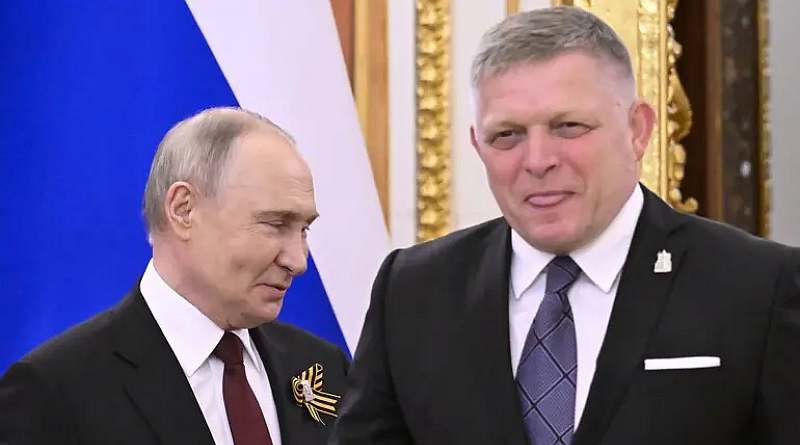
8. After Orban’s departure, Fico becomes Putin’s main ally in the EU.
– Slovakia is preparing to resume the intergovernmental commission with Russia, which has not met since November 2021. Prime Minister Robert Fico announced that the meeting will take place on November 25 in Moscow. After Viktor Orban’s electoral defeat, Fico becomes perhaps the only close ally of the Kremlin in the European Union.
– Among the main topics of discussion are the supply of Russian gas and oil, particularly through the “Druzhba” pipeline, as well as nuclear fuel for Slovak power plants. Slovak Foreign Minister Juraj Blanar opposes EU plans to gradually abandon Russian gas.
– The parties also plan to discuss the participation of Russian athletes in international competitions and cooperation in the fields of culture, tourism, agriculture, and environmental protection. The commission deals with economic, scientific, and technical cooperation.
– Moscow seeks to use Slovakia’s energy dependence to restore ties and weaken EU unity regarding Russia.
