
Myroslava Petsa, BBC News Ukraine, Warsaw
A drab and nondescript suburb of Warsaw becomes the center of European political gravity once a year.
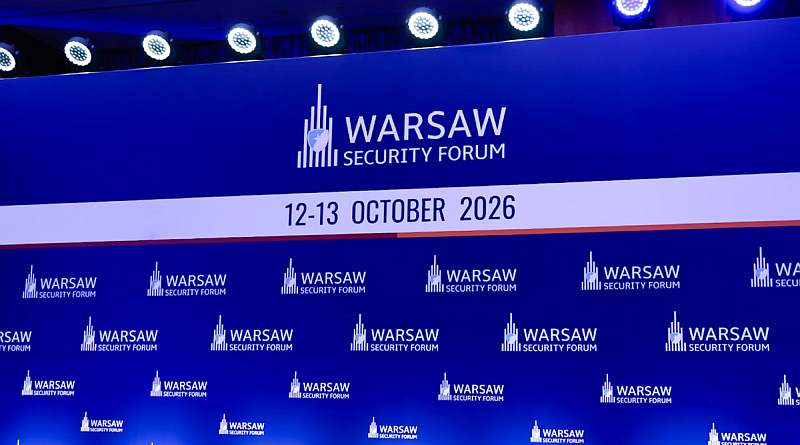
Here, in a four-star hotel, the Warsaw Security Forum takes place, bringing together hundreds of leaders and public figures from both sides of the Atlantic.
It is the third most important venue of its kind on the continent, after Davos and Munich.
Usually, everything here passes calmly and without sensation.
However, this year’s forum opened for the first time with the accompaniment of an air raid siren, tested in Warsaw.
And just two days before the start of the conference, Donald Trump announced a diesel deal between the US and Russia, and the next day proclaimed the start of an energy truce between Kyiv and Moscow. Despite this, on the night of October 14, Russia carried out the most massive ballistic strike on Kyiv’s energy sector in recent times.
The American press voiced threats from Washington to cut off Kyiv from American intelligence if the Ukrainian government did not agree to stop attacks on Russian refineries. A few days later, these predictions came true: the US, according to Zelensky, would not notify Ukraine about Russian ballistic missile launches and would limit the work of “Starlinks.”
Yet, as of October 12, the US-Russia “diesel deal” and the energy truce declared by Trump should have radically changed the entire mood of the forum and forced the main speakers to rewrite their pre-prepared but now outdated speeches.
However, it seems the hotel entrance became a portal to an alternative reality.
A reality in which Ukraine has guaranteed support from the entire West led by the US, NATO is an ultra-strong alliance, and partners’ promises are not revised according to mood.
“I would burn down every damn Russian oil refinery”

Throughout the two-day forum, the main focus here was on the American participants.
Yet, surprisingly, they were hardly asked about the US administration’s sharp turn towards Russia.
No one wanted to notice the elephant in the room.
As if the US was not planning to withdraw 25 to 40 thousand of its servicemen from Europe.
As if there was no diesel deal between the US and Russia. The agreement under which Russia was to immediately supply the United States with 2.25 million barrels of diesel, which is less than the daily US consumption of 2.94 million barrels, but already allowed for temporary lifting of US sanctions.
There were seemingly no accusations from the U.S. towards Ukraine for creating a diesel shortage in the U.S. due to strikes on Russian refineries, rather than the war in Iran.
On the contrary, American speakers competed to best praise the Ukrainian people’s resilience and bravery, and the Ukrainian army’s skill and ingenuity. All in unison called for strengthening support for Ukraine and providing it with everything needed to defeat Russia.
Former envoy of Donald Trump on Ukraine, Keith Kellogg, stated that Ukrainians should be allowed to do what they do well. The conflict between Kyiv and Washington was called rhetoric by the general, which would somehow resolve on its own. He added that in the Ukrainians’ place, he would “burn every Russian refinery.”
According to Kellogg, Russia will not win its war in Ukraine.
He said the same thing a year ago at the same forum and added that Russia would not be able to win a war against NATO if it dared to start one.
His main argument then was a calculation that Russia could muster 100 fifth-generation aircraft, while the five leading European countries have 400.
“We are told not to play our cards – this is recognition of Ukraine”

Still, a year ago, the U.S. reliably notified Ukraine about Russian ballistic launches. But on October 12 this year, after threats to cut off intelligence access, they did not warn for the first time, even though Ukraine did not strike Russian refineries.
Foreign Minister Andriy Sybiha was among the few Ukrainian participants at the forum.
He cautiously commented on the American demands not to strike Russian refineries: “In less than two years, we have gone from ‘you have no cards’ to a point where we’re told not to play our cards. This is true recognition of Ukraine.”
Addressing the American guarantors of the Budapest Memorandum, Sybiha called its signing a strategic historical mistake for which Ukrainians pay the highest price.
The moderator of the panel discussion, a former foreign minister of Iceland, highlighted the absence of notifications before Russia’s ballistic strikes on Kyiv on Monday. However, the main Ukrainian diplomat assured that Ukraine continues to receive intelligence from partners.
Just minutes later, President Zelensky would declare the opposite: no, Kyiv did not receive warnings from partners, primarily the Americans.
“Ukrainians Will Emerge This Winter with Even Greater Resolve”

The most anticipated event of the forum was expected to be the speech by NATO’s Supreme Allied Commander Europe, General Alexus Grynkewich, in which he planned to proclaim the “Theory of Victory.”
This is a strategy for deterring the Russian Federation, though in his speech, the general did not specifically mention Russia by name.
The “Theory of Victory” consists of three elements: blocking the initial attack, weakening and halting the advance, and ultimately defeating the warfare system.
General Grynkewich emphasized that the Alliance’s restraint should not be mistaken for weakness.
And if war comes to NATO, even though the alliance does not seek it, it is ready to defeat the aggressor: “If someone is foolish enough to attack us, we will fight. We will stop the attack and prevent them from achieving their goals, whatever they may be. We will ensure that any attack on any ally proves utterly futile.”
Admittedly, the aim of the strategy, as described by the general, is not a global strategic defeat of Russia on its territory, but solely the defense of NATO members.
The question of protecting the Baltic countries from a potential Russian attack and the speed of decision-making to come to their aid and jointly repel the attack hung in the air. However, Grynkewich responded that Americans are already present in Poland. And while the decision to deploy troops is political, “no one should doubt the commitment of the United States to the Alliance.”
Notably, US President Donald Trump himself recently compared NATO to a “paper tiger.”
General Grynkewich joined a chorus of voices praising Ukrainians for their resistance to the Russian war, calling them security guarantors, not just recipients of aid:
“Ukrainians have done an incredible job… The front line is largely stabilized. And this is a huge merit of the fighting spirit of Ukrainians, their innovative spirit… despite the difference in numbers and available resources.”
While acknowledging that Russian strikes on Ukrainian energy will “make this winter very hard” and attempt to “break the will of the Ukrainian people,” the general expects it will not succeed: “People have underestimated Ukrainians from the very beginning of this conflict. I am not going to make that mistake. They will get through this winter and emerge from it with even greater resolve and fighting spirit.”
And this as of October, despite several blackouts in the Ukrainian capital caused by Russia and the lack of encouraging forecasts for the winter.
“We abandoned you”
The Ukrainian forum participants, with whom the BBC managed to communicate, got the impression that Hrynkevych’s speech resembled a phrase by former Russian president Medvedev to pensioners in occupied Feodosia in 2016: “Hang in there, all the best, good mood and health to you.”
There was a lack of understanding of the extremely difficult situation in Ukraine on the eve of winter.
This understanding, however, was not lacking in the former commander of the US army in Europe, Ben Hodges. The usually cheerful general was gloomy.
“We (Americans) have abandoned you (Ukrainians),” the general replied to the BBC in the corridors of the forum when asked how he sees the development of the situation for Ukraine. And with a bitter smile, he added: “But you have Europe. They can and should help you.”
The four-star American general and former CIA director David Petraeus was not too optimistic either.
In a conversation with the BBC, he called himself “neither an optimist nor a pessimist, but a realist” and stated that, according to his forecast, it will be very difficult for Ukrainians in the war. But ultimately, the general believes, Ukraine can defeat Russia.
The Warsaw Security Forum was founded the same year Russia attacked Ukraine – in 2014.
This year’s theme was the old slogan “For our and your freedom,” which the Poles devised in the 19th century to support the Russian Decembrists.
With a correction for the current reality, this slogan means that the struggle of Ukrainians for their freedom cannot occur in a vacuum, and the outcome of the Russian-Ukrainian war also determines Europe’s fate.
There are no signs that this war could end before winter, which Volodymyr Zelensky and Donald Trump pondered in New York back in September.
After visiting the forum in Warsaw, it seems that the US partners in Europe are trying not to notice the transgressions in Washington and are trying to survive the next two years with minimal losses.
Meanwhile, pre-learned phrases about the resilience and fighting spirit of Ukrainians continue to sound. Despite the reality, where the front, with extraordinary efforts, holds, and Kyiv has already experienced several blackouts even before the start of winter.
All photos: Warsaw Security Forum
