

Volodymyr Zelensky’s statement about returning to strikes on Russian refineries raises hopes that we know exactly what we are doing. And that this decision is based on both military results and political consequences.
Diesel prices have become an important factor in the U.S. election campaign. But its logic demands above all to demonstrate resolve in the fight against high prices. The real result may come later — the main thing is for the voter to hear the promise and see the action.
The cessation of Ukrainian strikes alone will not restore the damaged Russian plants. Repairs, equipment, time are needed — weeks, and in some cases, months. Of course, the market reacts to expectations as well. However, there is a great distance between a political statement and additional volumes of diesel at American gas stations.
I am convinced that the organizers of the American election campaign understand this. However, a public dispute with the Ukrainian leadership could also be a way for them to demonstrate to voters the fight for cheaper fuel. Our statements in Washington can be seen as interference in the election campaign. And they can respond with very real decisions on which our defense capability depends.
At the same time, the logic of Ukrainian strikes on refineries has a convincing justification.
According to The Insider, each successful hit on a Russian refinery costs Russia an average of about 23 billion rubles. The cost of drones used for such strikes is incomparably less. Moreover, significant damage does not require destroying an entire plant: damage to critical equipment means costly repairs, production downtime, and loss of revenue. In the long run, this weakens the economy that finances the war against us.
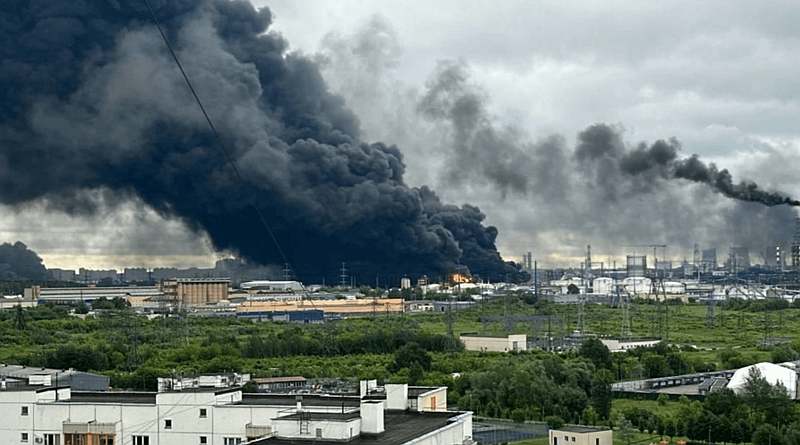
There is also an informational effect. This war is also taking place in people’s minds. A burning refinery is visible proof that the war is returning to the state that started it. A large-scale fire cannot be hidden, its footage is spread through television and social media. They are seen by Russians, Ukrainians, and our allies. They shatter the notion of Russia’s impunity and demonstrate the capabilities of Ukrainian weapons.
Thus, in terms of the cost-effectiveness ratio, economic damage, and informational effect, strikes on refineries are one of the most effective tools available to us. Dismissing their appropriateness would be wrong.
But the question of priorities remains.
In Russia, there are enterprises that manufacture components for missiles, military airfields, places for preparation and launch of drones that attack Ukrainian cities every night. There is also infrastructure crucial to the functioning of the Russian economy and management system. The Insider pays particular attention to the consequences of strikes on Yandex’s three data centers: the costs of restoration are compounded by the loss of users who lost access to services.
The recent strike with Neptunes on the Borisoglebsk airfield, where, according to Ukrainian military reports, six Su-34Ms were hit, also demonstrates the capabilities of our Armed Forces and weapon manufacturers. At the same time, we have fewer missiles than drones, they are more expensive, and different targets require different means of destruction. Therefore, claiming that any strike on a refinery can easily be replaced by a strike on a military airfield would be an oversimplification.
And yet, can we change our priorities for the few weeks remaining until the American elections without a significant loss of military results? Or will the consequences of such a pause be worse for us than the risks of conflict with the U.S. administration?
Especially when it comes to intelligence information and access to Starlink and Starshield satellite services, on which combat operations and the lives of our military depend. Reports on restrictions of these capabilities have already appeared.
The responsibility for the war and destruction of Ukrainian energy lies with Russia. Ukraine has the right to defend itself. The American election campaign cannot justify pressure on a country fighting aggression.
However, our leadership is obliged to consider even unfair circumstances if they affect the country’s ability to fight.
It remains to be hoped that the decision to continue strikes on Russian refineries is backed by a strategy that truly justifies these risks, that we understand what results we want, what the cost could be, and how we will act if the American administration implements further restrictions on support.
The ratio of the drone’s cost to the damage to a Russian plant is a strong argument. But state calculations must also consider the cost of potential consequences for our defense. The ultimate criterion is how much the decision strengthens Ukraine and its ability to protect people.
Photo: Telegram Exilenova+
