
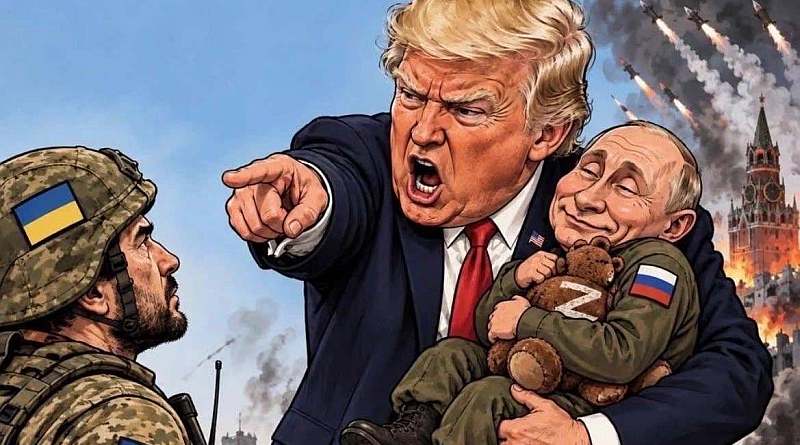
Timothy Snyder / Translation by iPress
Renowned American historian and publicist Timothy Snyder argues that Donald Trump’s foreign policy turns the weakness of the US into a factor that does not restrain but continues wars. In his opinion, the failure of the American war against Iran pushes Trump to make concessions to Russia, weaken sanctions, and effectively encourage Putin. As a result, he believes, Washington simultaneously harms Ukraine, undermines its own laws, and creates a dangerous precedent where aggression is rewarded.
We know the phrase “peace through strength.” Its logic is obvious. A strong country can deter others from waging war. A strong country can support rebuilding after conflict. A strong country attracts allies and builds relationships. When necessary, a strong country can win a war. Under Donald Trump, the United States is not a strong country in any of these senses or at all. Instead, it is a country that generates and continues wars through its own weakness.
Donald Trump increasingly and absurdly pretends to be a strong leader. But nowhere in the world is he perceived as such. And there are very valid reasons for this: a year and a half into his tenure, he has brought the situation to what can only be called superpower suicide. When I first spoke about the suicide of a superpower in April, I meant Trump’s swift and obvious defeat in Iran, his constant submission to the Russian dictator Putin, and domestic policies that undermine the future foundations of American strength. Six months later, this self-destruction has become even more apparent. The failure in Iran is now even harder to deny, and it has given Trump yet another reason to seek new defeat – this time in relations with Russia. Weakness has become a reason for even greater weakness.
The war in Iran is a strategic catastrophe. The United States gained nothing in exchange for thousands of deaths and billions of dollars spent. Within days, Americans squandered ammunition, including interceptor missiles that a more prudent country could have used to win a war or protect themselves. The US was forced to reduce its presence at bases in the Middle East and even withdraw strategic bombers from the United Kingdom – an unthinkable move during previous Middle Eastern wars and the Cold War years. The Strait of Hormuz has become a strategic weapon for Iran: the United States is unable to restore the oil route that worked perfectly before Trump started his whimsical war. Iran’s allies now attack US allies throughout the region with impunity. The Houthis have just attacked Riyadh airport, and now it seems unlikely that anyone can do anything about it.
From the very beginning, Trump had no chance of winning such a war. Although the US had incomparably greater military strength, it was led by people who did not understand how war works. It seems Americans convinced themselves that other countries would yield under the pressure of missiles and bravado; when this did not happen, there was no plan B. In fact, there wasn’t even a plan A – just “gender-affirming” shells and a horn of plenty of self-aggrandizement.
The plan was necessary given the very nature of war. War is a coercion to change the opponent’s policy. Wars are very rarely justified, but if they are fought, they should be taken seriously. Instead, all that this White House is capable of is frivolity. Although Trump and his Secretary of Defense, Pete Hegseth, talk about the extreme importance of their goals in Iran, there was never any real possibility of involving American troops for an invasion. Since Iran knew this from the beginning, it had the upper hand in escalation throughout the war. This means it can raise the stakes—for example, by blocking global oil routes or attacking American bases abroad—without fear of serious retaliation. To be clear: I am not saying that the United States should have invaded Iran. I am saying that starting a war without any idea of how to win it is a weakness, and that’s how it is perceived worldwide.
And now the war in Iran continues because Trump is weak. He has no way out and, at this stage, doesn’t even seem to seek it. The war is extremely unpopular in the U.S. and leads to rising gasoline prices, which Americans also dislike. In the current strategic situation, which Trump cannot change, he cannot make peace with Iran on terms that wouldn’t be humiliating. So he wouldn’t try to turn actual weakness into the appearance of strength.
It seems he wants the war with Iran to spill over into the U.S. so he can experience something like September 11th and receive a surge in popularity. What else, after all, can he hope to gain from this war? There remains only the weakness born of weakness, which, in the disaster he provoked, he might try to pass off as strength to the American audience. In his UN speech, he repeatedly linked Iran to the elections. During two recent campaign appearances, he fantasized about Iran destroying American cities. I don’t believe anything like that will happen, as Iran has no reason to give Trump such a gift. But it shows where Trump’s thoughts are directed: the weakness that led to a lost war could turn into weakness in the form of an inability to prevent terror, after which he can hope to once again become the “man of the moment.”
Weakness is dangerous, and Trump is dangerously weak. And, as is typical for weaklings, he blames others for his own failures, thereby only worsening the situation.
Global oil prices are high due to Trump’s Iranian adventure and his strategic defeat. Thus, guided more by the logic of his own character than by the logic of events, Trump blames Ukraine. I spent much of the past month in this country, where the injustice of these accusations was particularly palpable.
Russia was destroying Ukraine’s power infrastructure with ballistic missiles and even attacked Ukrainian gas stations with drones. Now missiles are breaching air defenses because the Americans are no longer supplying interceptors: they were either wasted over Iran or are being refused to be transferred or sold. Ukrainians risk their lives just trying to refuel their cars. Meanwhile, Americans pay more at gas stations because their president decided to start and lose a war in Iran.
Trump blames people risking death while trying to refuel for the costs Americans face, even though both problems are entirely caused by him, personally. Had he chosen to help Ukraine achieve victory instead of the catastrophic defeat in Iran where weaponry was wasted—this had numerous strong strategic arguments—Ukrainians would have missile defense, and Americans would have lower gas prices. Instead, Trump takes his own failure in this capricious war and tries to drag Ukrainians down with him. By blaming them for what he did himself, he finds an excuse to help his patron, Putin, which is evidently his main concern.
From the very beginning, for ten years now, the most obvious sign of Trump’s weakness has been his personal desire to obey Putin. This was noticeable during his first presidential campaign in 2016 and hasn’t changed since. Whatever the reason, he rarely misses an opportunity to assist the Russian dictator.
Since Trump returned to power in January 2025, American policy regarding the Russian-Ukrainian war has radically changed. Trump could have brought peace to Ukraine. He only needed to continue Biden’s policy of supplying weapons to Ukraine and enforcing sanctions. Instead, he chose a policy of war through weakness. Biden’s foreign policy may have been insufficient, but at least it was based on the correct premise: an aggressive war can only end when the aggressor faces resistance. Another year or two of such a policy would have been enough; Moscow’s only hope was the coming of a friend to power who would do even less.
Trump became that person. During the 2024 presidential campaign, Russian propagandists didn’t even try to hide their admiration for “our Trumpushka”: his weakness gave them hope for the continuation of the war. And he did exactly what Putin wanted. Trump stopped supplying American weapons to Ukraine and even their sale, and now he wants to support the Russian war economy by purchasing Russian diesel fuel.
This outrageous decision layered various manifestations of weakness. At first glance, the problem is that Trump is so weak domestically that he must pander to dictators abroad. It seems that due to high fuel prices at home, he’s looking for a quick fix before the elections. But this is unlikely to be the real motivation—unless Trump knows nothing about economics, and I must admit experience forces me to consider such a hypothesis. Buying diesel fuel from Russia will not change its price. It’s doubtful that Russia can even supply this fuel, as it faces a deficit on the domestic market itself. As is often the case with Trump’s deals, it could all end up with American taxpayers having to pay twice or thrice for what was advertised as a gift. But let’s imagine that Russian ships actually arrive in American ports with diesel fuel. This will only mean that Russia broke some previous contracts with other partners to make Trump feel grateful. The overall supply of diesel fuel on the global market won’t change. Neither will its price.
So, this step is symbolic, but the symbol is very important: Trump demonstratively positions the United States on the side of Russia. He pretends to help Americans and intends to harm Ukrainians just to promote Putin’s interests. The only consequence of undermining the sanctions regime against Russia is aiding Russia. And the price for this is very high, starting with the fact that the American executive branch violates American law. If the USA itself does not adhere to its own laws and practices regarding sanctions against the aggressor, it becomes easier for other countries to do the same.
The fact that Trump sided with Russia, gaining nothing in return for Americans, can already be considered a given. But he didn’t even gain anything for himself—unless, of course, he was paid. He only helped Putin by demonstratively violating the principle that aggressive war should not be rewarded.
Trump’s approach to Russia is a policy of pure submission. It is not just about the weakness of American policy that yields to the aggressor, which in itself would be bad enough. Nor is it only about weakness in the sense that Trump does what Putin wants, which would already be humiliating. It is about Trump fulfilling Putin’s wishes without gaining anything even personally—unless, of course, there are side agreements with personal payments. Given that Russia offered attractive oil deals to Americans who were supposedly negotiating peace, and those Americans turned out to be Trump’s son-in-law and his friend, this possibility should be considered more likely than not. Today, we no longer have foreign policy in the usual sense; we have clans circling around disasters created by Trump, trying to turn them into profit schemes.
This mixture of weakness and corruption is undoubtedly a strategic disaster for the United States and part of our suicide as a superpower. Much of our country’s strength is based on the fact that we enact laws and adhere to them. Buying diesel fuel from Russia is illegal due to the current American sanctions against Russia. The USA has not imported fuel from Russia since Russia launched a full-scale invasion of Ukraine in 2022. By law, the USA cannot buy Russian fuel until Russia withdraws troops from Ukraine. Moreover, just a few weeks ago, Trump signed a law obliging him not just to impose sanctions on Russian oil and gas, but also to punish other countries importing Russian hydrocarbons. This makes the situation, if even possible, even more grotesque, but there is a serious problem behind this. We weaken as a country when we cannot adhere to our own laws and instead follow a false “strong leader” seeking opportunities to submit to a real strong leader. Regardless of whether the president is Trump, we weaken ourselves as a state when our laws lose their meaning.
American weakness in Iran generates American weakness in relations with Russia, which in turn generates even greater American weakness in Iran. Even if you try to immerse yourself in the MAGA worldview and imagine that foreign policy priorities are indeed as Trump describes them, this step makes no sense and is blatantly contradictory. In MAGA propaganda, we are waging a righteous war against Iran, which is of world-historical significance. According to Trump, this war is so important that it would be worth losing American cities to continue participating in it. But… as everyone knows, Russia and Iran are close allies. They supply each other with weapons and intelligence, including targeting information. Iran supplies Russia with drones, and at the beginning of the war even sent instructors to the occupied territories of Ukraine to teach Russians how to use them. Russian nuclear specialists are actively working in Iran right now. Russia openly supports Iran in its war with the US. By sending hard American currency to Moscow, Trump helps Tehran. Trying to befriend Putin, Trump essentially seeks an alliance with a country that supports his enemy. Essentially, he is paying the other side to kill his soldiers.
By making American foreign policy openly pro-Russian, as otherwise this symbolic step is hard to understand, Trump has made the world significantly more dangerous. If Russia wins this war, aggressors around the world will be encouraged. Now, by stating that Ukraine should get rid of its elected president, which is outrageous in any context, Trump repeats Russian propaganda and supports the notion that it is the invaders, not voters, who should decide who should govern a country. Trump’s idea is for Ukraine to stop defending itself against Russia without requiring Russia to stop its attacks on Ukraine or offer peace—at a time when Russia is outright stating it has no intention of negotiating.
And of course, the reason Putin has no intention to negotiate is that the United States under Trump is incredibly accommodating—remarkably weak. Trump decided that the US should buy Russian diesel fuel after a phone call with Putin during which he was allegedly supposed to talk to the Russian dictator about a leak of the pneumonic plague pathogen from a Russian laboratory—an issue that raises serious questions that Trump is unlikely to ask. What a change of topic! It seems Trump has nothing to say in these conversations with Putin. He is putty in Putin’s hands. The irony is that Putin himself has very weak cards in the war against Ukraine. It’s only Trump’s weakness that makes him strong.
Trump, unable to win his senseless war against Iran, blames Ukraine for its consequences and uses this lie to justify lifting sanctions against Russia, thereby helping to prolong this other war as well. This is a war of weakness—not just as a fact, but almost as a belief or even a doctrine. America must lose, lose, and lose again, and wars must be started, prolonged, or encouraged, so that a few people around Trump can make money.
When Trump’s apologists find excuses for this, they add their own weakness to the overall picture, making the situation even worse. Trump is not a person to be entrusted with power of any scale. Pretending otherwise means participating in our ongoing suicide as a superpower.
Illustration generated by AI
